
Expiration Dates Versus What Your Nose Is Telling You
The printed date is a manufacturer’s opinion about flavor. Your nose is a wet biological sensor that has been rating garbage since before anyone invented pants.
Neither one should be running a kitchen unsupervised.
With one exception, the date on a package describes quality, not safety. The sniff test catches rot, and rot is the least dangerous thing in that refrigerator.
Both tools lie. They lie about different things, and only one of the lies ends with a person on the bathroom floor negotiating with God.
The germs that hospitalize you smell like nothing at all
Salmonella has no odor, no color, and no manners.
USDA sorts kitchen microbes into spoilage bacteria and pathogenic bacteria, and only the first group has the decency to announce itself.
Spoilage bacteria are the drunk roommate. Loud, revolting, weirdly harmless.
Pathogens are the quiet guy at the party who poisons the punch bowl and leaves before the ambulance shows up.
Federal meat guidance says so in plain English. Neither a shopper nor a butcher can smell dangerous bacteria on ground beef, no matter how confidently that nose gets deployed.
CDC counts 48 million foodborne illnesses a year in this country, and 3,000 of those people die, almost none of them warned by an aroma.
Food poisoning does not knock. It kicks the bathroom door in at 2 a.m. and asks whether you would prefer to sit or kneel.
Expiration dates versus what your nose is telling you
The date is a guess wearing a lab coat.
Companies land on “best if used by” through shelf-life testing and consumer taste panels, which means a stranger in Ohio chewed a cracker on a Tuesday and your yogurt inherited a deadline.
That stranger has never met your refrigerator. That stranger does not know about the container in the back that has developed opinions and possibly a spine.
Your nose has the opposite problem. Decades of field experience, zero clue what Listeria is up to.
The sniff test is a quality instrument that people keep swinging around as a safety instrument.
Running a kitchen on the date alone is how perfectly good cheddar gets executed without a trial. Running it on the nose alone is how a turkey sandwich gets someone hospitalized.
Nobody in Washington printed that number
Only infant formula is legally required to carry a date in the United States.
Everything else got dated because a company felt like it.
Roughly a third of American adults believe the federal government regulates date labels, a level of misplaced faith normally reserved for horoscopes and gas station sushi.
No inspector is standing over the mayonnaise with a stopwatch. There is a printer, a legal department, and a guy named Doug who wanted to go home.
Your nose is out of warranty
About 13.5% of adults fail an objective scratch-and-sniff test, and most of them have no idea it happened.
Meanwhile 86% of consumers say they smell food to decide whether it is still good.
Stack those two numbers and roughly one in eight confident sniffers is a judge who cannot hear the testimony.
Where the sniff test is undefeated
Milk is the easiest call in the entire refrigerator, and everyone still performs the ritual like a bomb technician on the last day before retirement.
Cap off. Arm extended. Squint. One brave huff.
Then comes the sacred marital act of shoving the carton at a partner and asking whether it smells weird to them. Some couples never get closer than that.
Soured milk is disgusting and basically harmless. A Harvard food policy expert notes that curdled milk will not give you food poisoning, because pasteurization already dealt with the murderers.
The face knows before the brain does. That involuntary head-jerk is 200,000 years of dead ancestors screaming in unison.
Trust the nose on these:
- Milk and cream, which go from fine to biohazard with all the subtlety of a car alarm.
- Bread, where visible fuzz is the only vote that counts.
- Hard cheese. Cut an inch around the mold and get on with your life.
- Produce. A cucumber with the structural integrity of a water balloon has left this world.
- Butter and cooking oils, which taste like crayons long before they turn hostile.
- Dry pasta, rice, and beans, which are still fine two years after everyone assumed the worst.
None of that requires a printed number. It requires eyes and one functioning nostril.
Where the sniff test gets you humbled
Deli meat is the trap.
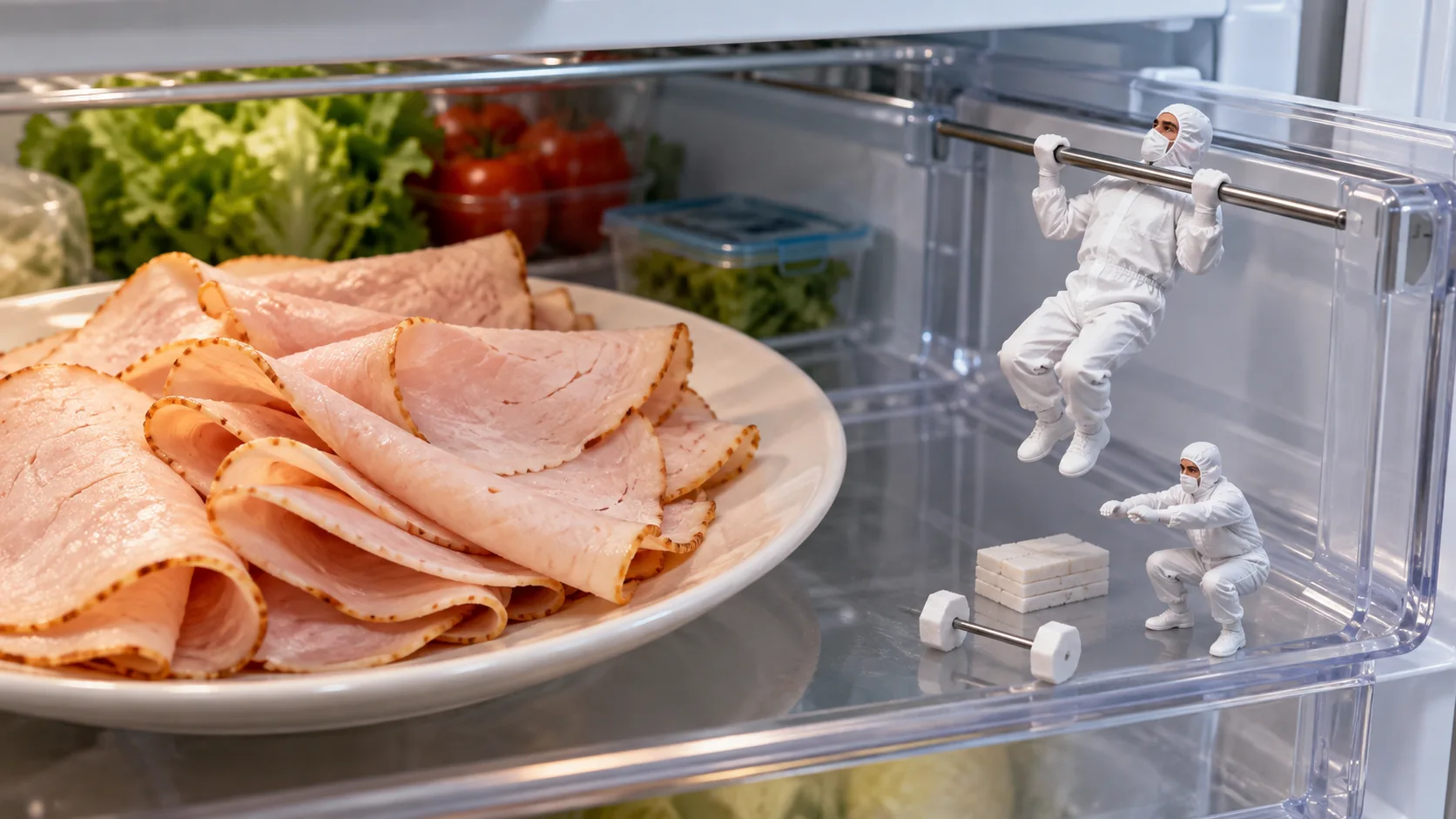
Listeria keeps multiplying below 40 degrees Fahrenheit, which means it is doing pull-ups in the cold cuts drawer while every other microbe naps.
Turkey slices that smell like absolutely nothing can still ruin a month.
Leftover rice is the other ambush. Bacillus cereus survives the pot, throws a rager once the rice hits room temperature, and leaves behind a toxin that reheating cannot undo.
Doctors call one version of it fried rice syndrome, the only illness in medicine named after a takeout order.
These are the foods where the date and the storage clock outrank your face:
- Deli meat, hot dogs, soft cheeses, and anything scooped from a salad bar, especially for anyone pregnant or immunocompromised.
- Cooked rice and pasta abandoned on the counter for a leisurely four hours.
- Ground meat, which has vastly more surface area for bacteria than a steak and smells identical either way.
- Any can that is bulging or leaking. A can doing a push-up is a can with plans.
- Anything that spent the night in a car.
- Raw sprouts, grown in the exact warm damp conditions that pathogens fantasize about.
Also, stop taste-testing. Sampling a suspicious leftover to see if it fights back is not a safety check, it is a hostage situation where you volunteered.
Canned soup deserves the opposite treatment. Shelf-stable goods stay fine for years past the stamp as long as the container is not doing anything theatrical.
The money going straight into the bin
Date panic is expensive in a way that would humiliate most households if they ever saw the receipt.
An average family of four throws out roughly $1,500 of uneaten food a year.
That is a vacation. It is currently fermenting in a Hefty bag next to a coffee filter.
In 2016, 84% of consumers said they discarded food near the package date at least occasionally, and 37% did it always or usually.
By 2025 that had climbed to 88% at least occasionally and 43% always or usually.
Fear went up while the science stayed exactly where it was, which is a hell of a career for a number printed by a marketing department.
Now compare that to the real threat.
Foodborne illness costs the country about $75 billion a year in medical care and lost productivity, and almost none of it traces back to cottage cheese that was three days past a suggestion.
The panic is aimed at the wrong shelf entirely. Households keep executing innocent yogurt while the deli meat strolls out the back door whistling.
What to do tonight
Buy a refrigerator thermometer for about seven dollars and confirm the box is holding 40 degrees Fahrenheit or below.
Built-in displays lie constantly, and a fridge quietly cruising at 44 degrees turns every one of these judgment calls into a coin flip with your colon.
Read the date on the deli meat. Sniff the milk. Get leftovers into the cold within two hours.
And apologize to the soup. It has done nothing wrong.


