
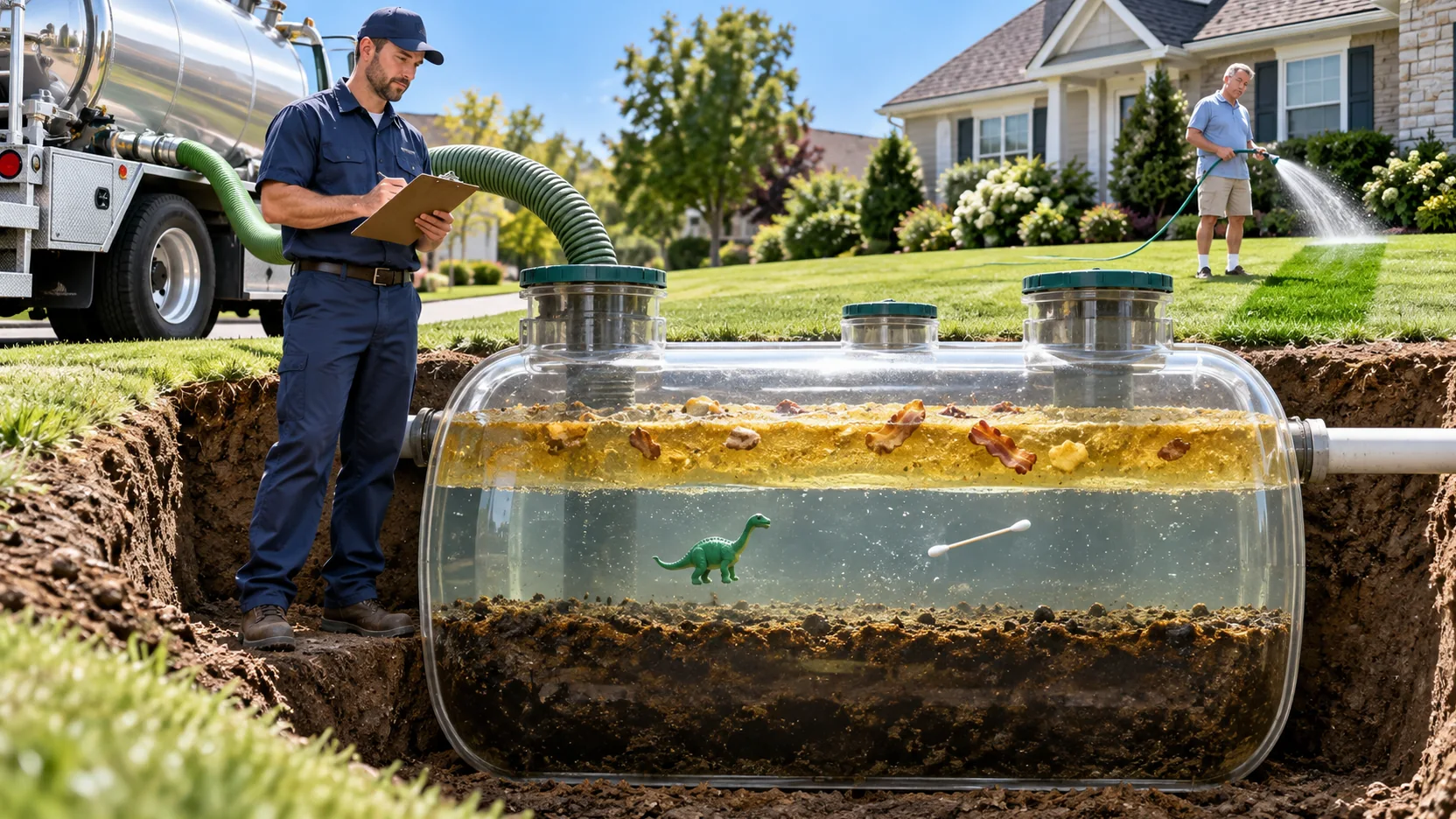
What Your Septic Tank Guy Knows About You and Won’t Say
Your septic tank guy knows what you eat, roughly how much you drink, how many people sleep in your house, and whether the word “flushable” has ever personally fooled you.
He knows because a septic tank is not a hole in the yard. It is a filing system with a lid on it.
Heavy things sink. Greasy things float. The liquid in the middle drains off into the soil like a rumor leaving a party.
What stays behind is a layered, dated, weirdly honest account of your household.
He will not mention a word of it.
He will tell you the tank looks about right, take your check, and drive off with three years of your business sloshing behind him at forty-five miles an hour.
What your septic tank guy knows about you and won’t say
The bottom layer is sludge, which is the industry’s gentle word for everything your body fully committed to.
The top layer is scum: fat, soap, and whatever the air fryer could not forgive.
Since the EPA counts more than 26 million American homes on septic systems and recommends pumping every three to five years, that tank is not a snapshot of you. It is a boxed set.
Legible to any man with a flashlight and no particular wish to make eye contact with you:
- How many people live there, which is frequently not the number you told him on the phone.
- Whether you cook, or whether you have simply been reheating a series of decisions.
- The guest bathroom nobody supposedly uses, which has been used the way a truck stop gets used.
- Cotton swabs, dental floss, cat litter, cigarette butts, one contact lens case, and a small plastic dinosaur. The tank keeps receipts. It does not accept explanations.
- Your lawn. If one stripe of grass over the drainfield is greener than everything around it, that patch is not blessed. It is fed.
None of this gets said out loud. He has a truck to fill and a lunch he is trying very hard to still want.
Grease
That floating scum layer is a food diary.
The EPA has attributed 47% of reported sewer blockages to grease from homes, restaurants, and industry, making bacon the leading cause of plumbing collapse in the developed world.
Nobody pours grease down the drain on purpose. They pour it down the drain at 11:40 at night while telling themselves that hot water counts as a plan.
Hot water does not count as a plan.
Hot water moves the problem eleven feet from the sink, where it cools into something with the structural integrity of a hockey puck and the personality of a landlord.
Multiply that by three to five years and the guy pumping your tank is not looking at last night’s dinner. He is looking at an era.
The wipes are lying to you and he has the evidence
In 2017, Thames Water found a 130-tonne mass under Whitechapel Road that was 250 metres long and built mostly of cooking fat and wet wipes.
It took nine weeks and a crew with shovels to kill it.
The official composition also included diapers and condoms, which is either a sanitation emergency or the most honest autobiography the city of London has ever published, depending on your feelings about Londoners.
There is no legal standard for the word “flushable.” A golf ball is flushable once.
New York City spent more than $18 million pulling wipes out of its sewers by hand, meaning somebody’s actual job title involved reaching into that.
Kimberly-Clark later agreed to a $20 million settlement over flushability claims, conceding nothing.
So here is the position nobody in the wipes aisle wants stated out loud: the “septic-safe” ones are worse for you than the cheap ones.
Same fabric, same refusal to disintegrate, except now a reassuring label has talked you into flushing it. You paid a premium for permission to sabotage yourself.
Buy whatever wipes you like. Use them with real confidence. Then put them in the trash like a functioning adult who understands that a toilet is a door, not a disposal.
Your toilet is a snitch with a chemistry degree
Sewage can be read like a blood panel, and it has been for about twenty years.
Researchers sampling wastewater in Milan, Lugano, and London measured community use of cocaine, heroin, cannabis, and amphetamines straight out of the influent. No surveys. Nobody admitted anything to anybody.
The field is respectable now. The United States built a national wastewater surveillance network after the pandemic, and researchers writing in Nature Water have argued for aiming it at opioids and methamphetamine too.
Here is the part that should make you sit up, or possibly sit down.
Every one of those city-scale studies runs on a sample where hundreds of thousands of strangers dilute each other into a comfortable average.
Your septic tank extends no such courtesy. It is a sample size of one household.
Whatever a lab can detect across a city of 400,000 people, it could detect in your backyard at roughly the concentration of a confession.
Nobody is doing this. There is no van outside.
Your pumper could not possibly care less what you got into at your cousin’s wedding.
But the information is sitting out there in a concrete box, under a green rectangle of suspiciously happy grass, waiting on a science that already exists.
Sleep well.
Why he says nothing
Partly because he is a professional. Mostly because you are not that interesting.
The man has seen a tank so neglected it had a crust you could park a bicycle on.
He has met the woman who swore her system was fine while her yard was audibly making a noise. Your grease layer is a Tuesday to him.
The silence is also strategic. Anything he says out loud becomes a conversation, conversations happen next to the truck, and the truck is running.
So you get the two approved sentences. She’s about full. You’re due in a few years.
Translation: I have read your entire deal and I would like to be paid.
The lecture he would give if you asked for it
Ask him and the poker face drops so fast you can hear it land.
Start with the additive aisle, that shelf of bottles promising to feed your tank the good bacteria.
Washington State University Extension points to a study of 48 septic tanks that found no difference in sludge levels between tanks given additives and tanks left completely alone.
The University of Rhode Island’s onsite wastewater program answers the enzymes-and-yeast question with “Absolutely not!”, exclamation point included, which for an extension publication is howling.
Worse, some additives chop solids into pieces small enough to drift out to the drainfield.
You did not treat your tank. You fired it out of a cannon into the most expensive part of your property.
A few other things he would say, between drags:
- Garbage disposals are an appliance for people with sewers. University of Minnesota work on a simulated septic tank found food waste raised total suspended solids by 31.3%, so you have signed up for extra pumpings rather than own a compost bin.
- Bleach in normal amounts is fine. Bleach as a lifestyle is not.
- That running toilet is not a quirk of the house. EPA puts household leaks at up to 180 gallons a week, and every gallon shoves your solids toward the drainfield ahead of schedule.
- Nothing goes in that did not go through a person first. Paper is the single exception the tank has agreed to.
- Park somewhere else. That is not a driveway, it is a lid.
Put that leak figure next to the pumping schedule and you get the joke at the center of most emergency calls.
The homeowner rarely gets punished for what they flushed. It is usually a four-dollar rubber flapper they have been listening to for eight months and describing as character.
Do not open the lid
This is the one thing he will say out loud, in a flat voice you have not heard him use before.
Penn State Extension uses eight words: “Never enter a septic tank for any reason.”
The gas coming off that sludge is hydrogen sulfide, and its signature move is killing the rescuer.
OSHA documents four workers dying in one underground station, one after another, each going in after the last.
A review of federal records counted 80 occupational hydrogen sulfide deaths between 1984 and 1994, with 19 of the dead being coworkers who went in after somebody else.
That should end any argument about having a quick look.
It smells like rotten eggs at low concentrations and like nothing whatsoever at high ones, because it switches your nose off first. The one warning you were counting on is the first thing it takes.
So no, you may not have a peek. Your curiosity is not equipped for this.
Before he shows up next time
Go find the lid while it is still daylight and you still have your dignity. Measure from a corner of the house, write the number on masking tape, stick it inside a kitchen cabinet.
Then when he pumps, ask what the scum layer looked like and how deep the sludge measured.
He will tell you. The man has been waiting years for somebody to ask him a question other than whether he can smell it.


