11 Questions to Ask Before Letting a Stranger Pierce Your Bellybutton at a Flea Market
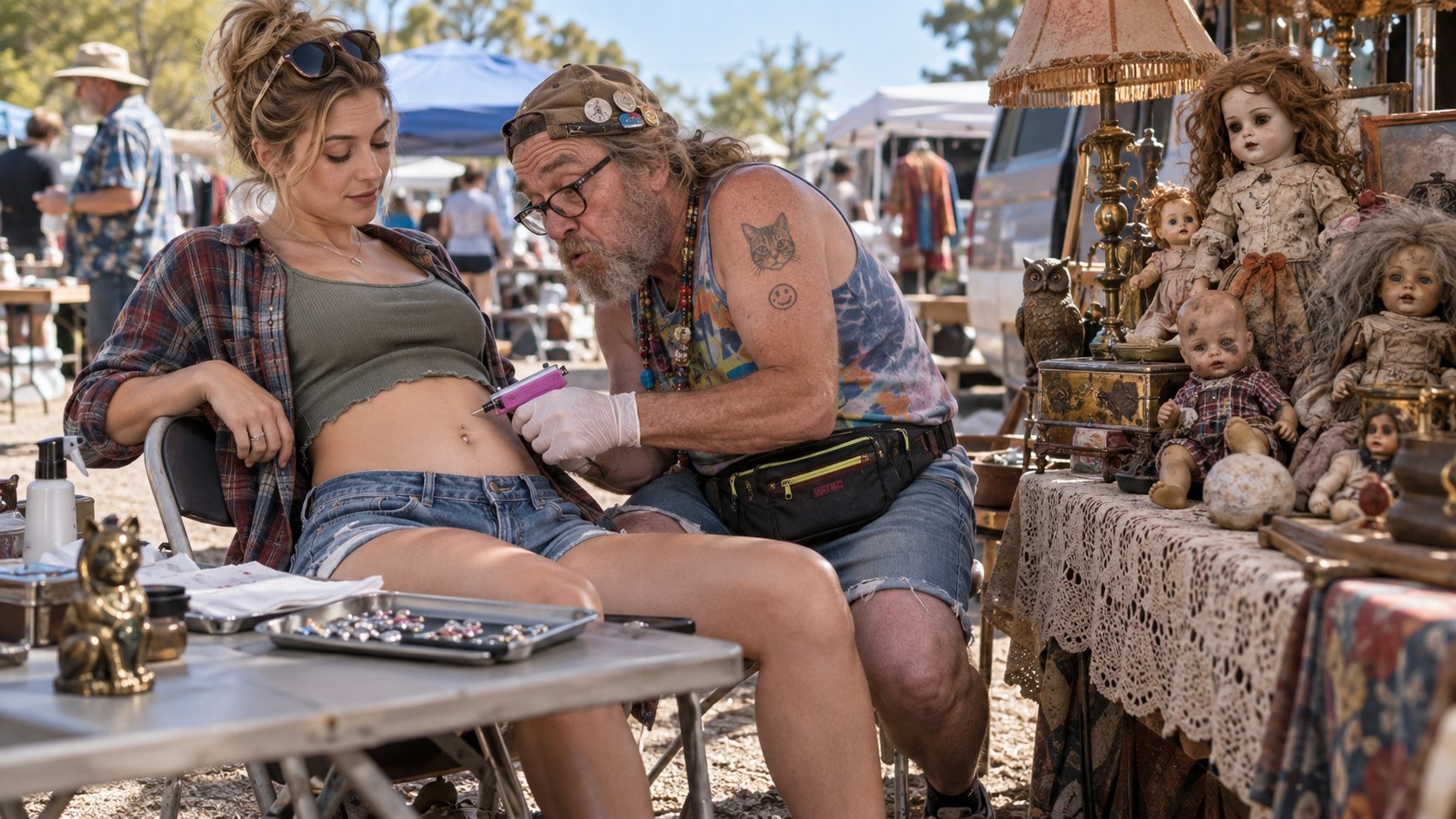
A flea market bellybutton piercing is a stranger punching a hole in your torso, usually within spitting distance of a table full of haunted dolls.
Before his hands go anywhere near your waistband, ask about sterile needles, licensing, jewelry metal and his blood alcohol level.
A shrug means keep your shirt on.
People grill a seller harder over a used lawnmower than over the 11 questions to ask before letting a stranger pierce your bellybutton at a flea market.
- A piercing gun anywhere near your belly is an automatic no.
- Sealed, single-use needles and a spore-tested autoclave, or nothing.
- Implant-grade titanium or solid gold. Not “gold-ish.”
- Healing takes months, and the guy with the folding table will be in another zip code by Sunday night, taking his entire customer service department with him.
1. Why Is a Stranger Piercing Bellybuttons at a Flea Market?
The National Flea Market Association counts over 1,100 U.S. flea markets and roughly 2.25 million vendors selling everything from tube socks to a raccoon in a tuxedo.
Divide those numbers and each market averages about 2,000 sellers.
Statistically, one of them was bound to stare at a stranger’s midsection and think, “I could put a hole in that.”
Ask him why, because “the tattoo guy retired” is not a medical credential.
Neither is “I did my cousin’s in a Waffle House parking lot, and she only cried a normal amount.”
2. Is That a Piercing Gun in Your Fanny Pack, or Are You Just Happy to See Me?
Both answers are bad.
The Association of Professional Piercers says plastic piercing guns can’t be autoclaved, and blood from one customer can aerosolize inside the gun. Brenda’s Tuesday is now inside your Saturday.
The same group calls using those guns on navels “absolutely inappropriate and very dangerous.” That’s trade-group speak for “sweet merciful heavens, put that thing away.”
Standard advice says to ask whether the gun got cleaned. Stop asking that. It’s like asking whether the porta-potty got “freshened up” before you sit down bare-cheeked.
Guns usually get a quick wipe with disinfectant, and environmental health officials warn that wiping can’t kill the pathogens hiding in the working parts.
The only question that matters is whether a gun exists at all. If one does, zip up and leave.
3. How Many Beers Deep Are You, and How Many Am I?
Texas studio licensing rules bar piercing anyone under the influence of drugs or alcohol. Texas sells beer at gas stations, and even Texas drew the line here.
Flea markets run on warm Bud Light and whatever Skeeter is pouring out of that unlabeled cooler.
If the piercer’s breath could strip paint off a Buick, his hands aren’t steady enough to thread a needle through a love handle.
Same rule for you. Drunk you already agreed to karaoke, a gas station hot dog, a free futon and a 1 a.m. text to your ex. Drunk you doesn’t get a vote on body modification.
4. Where’s Your Autoclave, and Why Does It Look Like a Crock-Pot?
An autoclave is a steam sterilizer, basically a pressure cooker that murders germs instead of making pot roast.
The CDC says steam sterilizers should be monitored at least weekly with spore preparations, which are vials of tough-guy bacteria used to prove the machine can kill.
Illinois tells customers to ask about the establishment’s monthly autoclave spore test results. Ask the flea market guy for his, then watch his face. Men have looked less confused reading a pregnancy test.
Plenty of flea markets only open on weekends, so a weekly spore test would mean testing nearly every time he unfolds his card table.
The odds of that match the odds his Rolex ticks.
5. Can I See Your License, or at Least Something Laminated?
Costco cards don’t count.
Texas offers temporary event licenses for tattooing and body piercing that cover one event for no more than seven days.
The CDC warns hepatitis C can spread through piercings done in unlicensed facilities, informal settings or with non-sterile instruments. A folding table beside the ferret guy can check every box before lunch.
6. Did That Needle Come From a Sealed Package, or From Your Sock?
Mayo Clinic’s piercing safety guidance calls for a sterile, disposable needle and fresh gloves for every piercing. Contaminated gear can pass along hepatitis B and tetanus.
Treat the needle package like a condom wrapper. Sealed until you watch it open, and never reused by anybody named Dale.
Most piercing checklists start by flipping through the artist’s portfolio. At a flea market that’s backwards, because a gorgeous photo album says nothing about the needle that just rolled through funnel cake grease.
Check the packaging before the pictures, then check his hands. If he’s wearing the same gloves he used to count cash and scratch his undercarriage, your belly is closed for business.
7. What Is This Belly Ring Made Of, Exactly?
“Metal” isn’t an answer.
The jewelry standards for fresh piercings call for implant-certified titanium meeting ASTM F-136, or solid gold that’s 14k or higher and free of nickel and cadmium.
Plated gold gets rejected outright, since the coating is measured in millionths of an inch and can chip off.
A flea market belly ring is “14k” the way gas station cologne is “Italian.” Ask for a mill certificate, the paperwork proving the metal’s grade, and don’t accept a crumpled receipt from Claire’s.
Now stack that plating problem on top of North American patch-test data showing 17.5 percent nickel sensitivity. The gold flakes, cheap metal hits raw wound, and roughly one in six buyers just purchased a rash.
The same research suggests nickel sensitization may climb with the number of piercings. Every sketchy hole is a loyalty punch card for itching.
Plenty of people plan to start cheap and upgrade later. Wrong order.
The starter ring sits inside an open wound for months, which makes it the single worst time in your life to shop the clearance bin at a place that also sells nunchucks.
8. How Long Until This Thing Heals?
Longer than the relationship that talked you into it.
American Family Physician puts navel healing at up to nine months, blaming tight waistbands for slower healing and more infections. Low-rise jeans are back, on doctor’s orders.
NPR’s report on body piercings gone wrong flagged bellybuttons as especially trouble-prone, with full healing taking up to a year. It also advises skipping sit-ups.
Finally, a medical excuse to skip crunches. The gym you ghosted in March won’t notice.
Nine months from the doctors, a year from NPR. Your navel now has the gestation period of a human baby, plus a few weeks of that baby being overdue and cranky.
That seven-day Texas temporary license could expire fifty-two times over a year of healing.
The flea market guy, meanwhile, will be three states away by Sunday with no phone number and a brand-new ferret.
9. What Happens If It Gets Infected?
Odds aren’t great.
Among people pierced somewhere other than the earlobe, 23 percent reported a medical complication in national survey data cited by StatPearls. One-third of pierced people got at least one piercing outside a body art studio.
Nearly one in four of those adventurous holes goes sideways with professionals in the mix. A guy parked between bootleg DVDs and beef jerky won’t improve those odds.
See a doctor, not the ferret guy, if any of these show up:
- Redness spreading like gossip at a church potluck.
- Swelling.
- Pus, especially green pus with a smell that clears a room faster than Uncle Ray after chili night.
- A fever, which means your whole body has joined the complaint.
- Red streaks running away from the hole, because even your skin wants out.
10. Can I Still Have Sex With This Thing In?
Yes, with rules.
The Association of Professional Piercers’ piercing FAQ says all sexual and oral contact must be made “fluid safe” during healing. In plain English, nobody’s mouth goes near your navel for months.
That rules out body shots. Sorry, Cancún.
A partner’s tongue and general enthusiasm stay behind a barrier until the thing heals. Romance takes a hit, and so does whoever brought the whipped cream.
A fresh belly ring snagging on a partner’s belt buckle mid-thrust produces a noise normally reserved for startled goats.
11. What’s Your Return Policy?
There isn’t one.
Flea market sales are final, and scar tissue follows the same policy with far less haggling.
He won’t take the belly ring back, won’t refund your twenty bucks and definitely won’t meet you at urgent care to split the copay.
So buy the kettle corn and skip the haunted doll. On Monday, book a licensed studio, ask to see the spore test log and let a professional poke you in a room with a sink.
If the folding-table guy looks hurt, tell him it’s not him. It’s the fanny pack.