Signs the Blood Drive Van Is Not Affiliated With Any Hospital
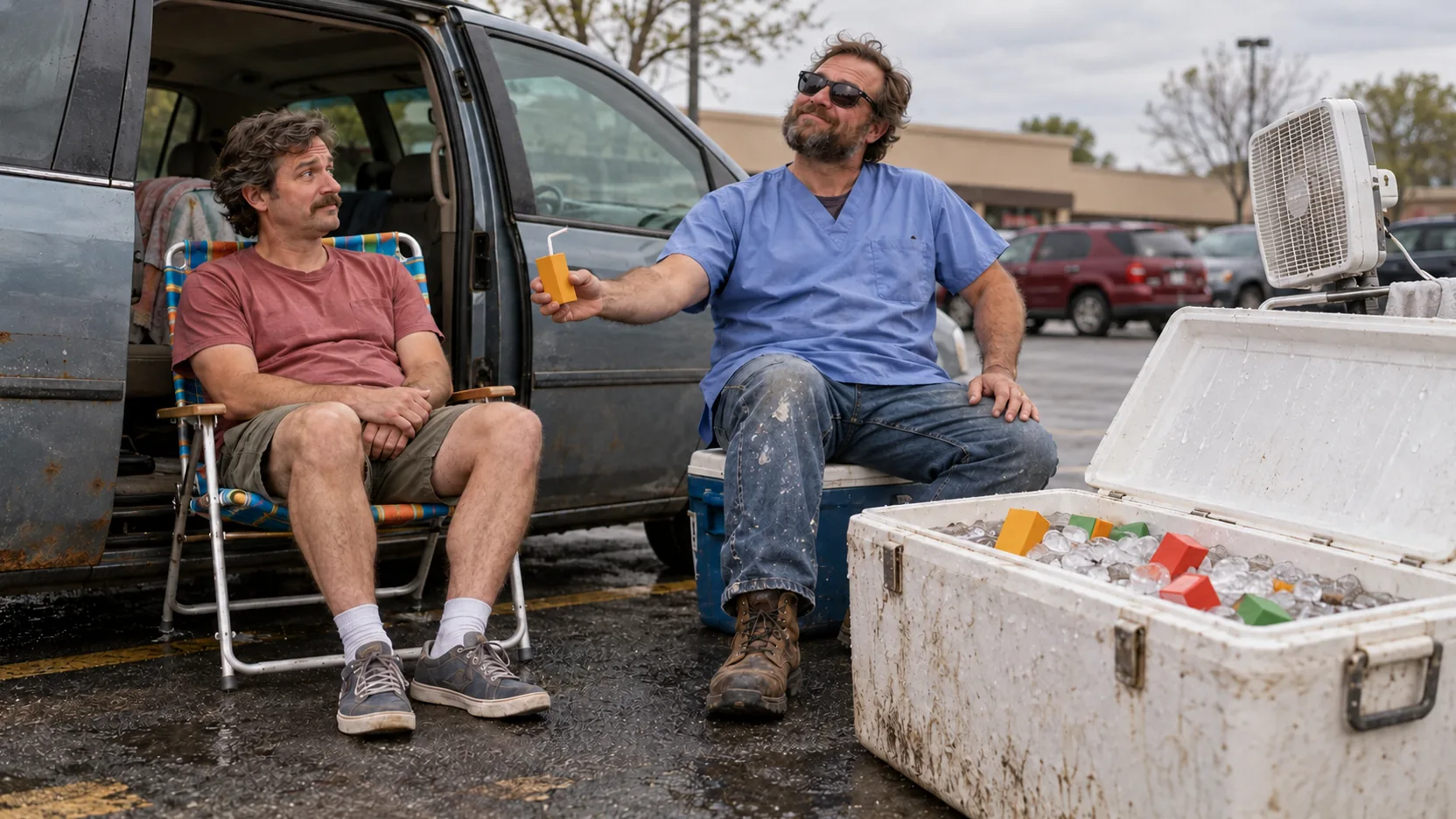
Nothing inspires medical confidence like a Dodge Caravan with a red cross painted on the side in what is unmistakably nail polish.
Real bloodmobiles park in these same lots, hand out these same cookies, and hire nurses who can find a vein through a winter coat.
This one has a beach chair, a bath towel, and a man calling your arm the good one like he is appraising livestock at auction.
Start With the Van Itself
The van is not the tell. Legitimate ones do most of the collecting, and plenty of them look this rough from the curb.
Nearly two thirds of whole blood donations in one national donor hemovigilance study came out of mobile collection vehicles.
So the thing is hiding inside the most crowded costume in medicine, which is the only clever move it makes all day.
Look at the lettering on a real fleet vehicle.
A unit number and a vinyl wrap that cost more than the van.
A real bloodmobile has a name. Not a hospital’s name necessarily, but a blood center’s name, spelled the same way in two places.
This van has three fonts and two spellings of the word donation.
This one has a magnet. The magnet says GENERAL HOSPITAL, which is a soap opera, and it is peeling upward like a bad toupee.
The door decal promises he is AFFILIATED WITH AREA HOSPITALS, plural and unnamed, the way a menu promises fresh seafood in Nebraska.
Hospital fleets get lot permission in writing, weeks ahead, from a property manager with a clipboard fetish and a lanyard.
This van is wedged between a dumpster and a Sbarro.
The paper temp tag is from two states away and curling in the drizzle.
Check the back doors. A working unit has a lift gate, a generator, a fire extinguisher, and a stripe of road grime it earned honestly.
These doors have a bungee cord and a hand-painted arrow reading DONATE, aimed helpfully at the bumper.
Refrigeration is the entire job, and refrigeration does not run on enthusiasm.
His power supply is a cigarette lighter adapter with three things plugged into it, and one of them is a vape.
Count the staff. A real unit runs a phlebotomy team, a screener, a driver, and someone whose only job is watching people not fall over.
He is the entire team, which he announces with pride, in scrubs worn over jeans and work boots with paint on them.
The Screening That Isn’t
A real drive interrogates you about medications, tattoos, travel, and the last few months of your sex life until you start confessing unprompted.
The van asks two questions. Your blood type, and whether you drove yourself here.
There is supposed to be a private booth for the questionnaire, because some of those answers end friendships.
Your booth is the sliding door, propped open with a milk crate, in front of everybody waiting behind you.
The finger stick is not decoration.
It stops an anemic stranger from surrendering a pint and then operating a riding mower.
This operation’s hemoglobin screening is a man leaning back, studying your face, and announcing with real confidence that you have terrific color.
A legitimate drive scans your photo ID against a deferral database. This one wrote your name on masking tape and misspelled it.
Real screeners will deny a donor over a fever, a blood pressure reading, or a Tuesday they did not care for.
Nobody has ever been turned away from this van, because turning people away costs money.
| The Part That Matters | Accredited Bloodmobile | Guy With a Van |
|---|---|---|
| Hemoglobin check | Finger stick, calibrated meter, hard cutoff, no negotiating | Squints at you and says you have terrific color |
| Identity check | Photo ID run against a deferral database | Your first name on masking tape, misspelled |
| Health history | Dozens of questions on a tablet, in a private booth | Two questions, one of which concerns your car keys |
| The needle | Sealed, single use, unwrapped where you can watch | Already out of the package and somehow warm |
| Rest period | Ten supervised minutes, juice, staff watching for the wobble | Firm handshake and walking directions to the bus stop |
| Bag label | Donor classification, blood type, unit number, barcode | Sharpie, first name, smiley face |
Mobile drives should be barred from operating without a working thermometer, a working cuff, and a working reason to exist.
The masking tape is not a small thing.
A bag nobody can trace back to a donor cannot be pulled back from whoever ends up on the receiving end of it.
Federal labeling rules go further and require that a unit intended for transfusion state paid donor or volunteer donor on the container.
That phrase has to be printed no smaller than the name of the product, which is a hell of a thing to hand-letter in Sharpie.
Ask him which hospital receives the units, then watch the sentence collapse in real time while he picks a direction.
He will say something regional and vague. The trauma center. Upstate. Downtown. One of the big ones.
What’s Inside, in Order of Alarm
Start with the floor.
No clinical space on earth has carpet, because carpet keeps everything forever in a way nobody wants explained out loud.
You are hauling nine to twelve pints of blood. A real whole blood donation takes about 450 mL of it.
That is about a pint, which is survivable in a clinic and a coin flip in a Caravan.
A real bloodmobile is a clinic bolted to a chassis. This interior is a garage sale that learned some medical vocabulary.
- A beach chair with a Corona logo, reclining at exactly one angle, which is upright.
- The cooler. Styrofoam clamshell from a bait shop, sweating onto a phone book.
- Half a sleeve of saltines, no juice, and a Red Bull with somebody else’s lipstick on the can.
- A five gallon paint bucket labeled SHARPS in marker, which at least demonstrates awareness of the concept.
- The scale. Bathroom model, 1987 vintage, because someone told him weight matters and he stopped listening immediately after.
- One box fan, aimed at the driver.
There is also a Bluetooth speaker thumping away, which the literature would politely call elevated noise in a confined space.
Look for a refrigerator with a temperature chart taped to it, logged by hand, twice a day, forever.
His fridge is a bait cooler and his log is a Post-it saying COLD.
Now put down the needle paranoia for one paragraph, because the scariest item on that list is the seating.
In that same national data, 371 of the 1,120 fainting episodes struck during the rest period after donation rather than during the draw.
The cookie table is the medical device here. This van threw out the safety equipment and kept the sharp part for itself.
First-time donors in that study reacted at roughly three times the rate of repeat donors.
Collection vehicles posted the worst reaction numbers of any site type, which is a hell of an endorsement for the format.
The suspected culprits were crowding, noise, heat, and lousy air circulation. He has assembled all four and aimed the fan at himself.
Where Your Pint Ends Up
Your pint has a going rate.
A survey of more than 200 hospital blood banks put average acquisition cost at $210.74 per unit of red cells and $533.90 for apheresis platelets.
None of that money is reachable from a minivan. Red cells survive 42 days between 1 and 6 degrees Celsius, monitored the entire time.
A validated hospital cooler buys six hours before the unit has to come back.
His bait cooler bought maybe forty minutes and a warm Gatorade.
| Component | Where It Has to Live | How Long It Survives There | Condition in a Bait Cooler |
|---|---|---|---|
| Red cells | 1 to 6 degrees Celsius, monitored | 42 days | Ruined before lunch |
| Platelets | Room temperature, gently agitated, never chilled | 5 days | Chilled, insulted, deceased |
| Plasma | Frozen at minus 18 Celsius or colder | About a year | A slushie with ambitions |
| Cryoprecipitate | Same freezer, same rules, less forgiveness | About a year | Also a slushie |
| Whole blood in transit | A validated cooler with a return deadline | About six hours | Riding beside the Gatorade |
A real drive can tell you which hospital got which unit, three years later, on a Sunday.
Every real unit also gets screened for a menu of infectious diseases in a licensed laboratory before it goes near a patient.
His laboratory is a bait shop lid and a cigarette lighter with a vape in it.
So the pint is garbage before he reaches the highway, which is the dumbest part of the entire crime.
He has not stolen anything worth two hundred dollars.
He has manufactured medical waste out of a stranger and cost that stranger the next 56 days of donating.
The prize wheel promises a flat screen television, which is not how a nonprofit thanks you for eleven minutes of bleeding.
The legal version of selling your fluids pays considerably better anyway.
Plasma centers compensate donors $100 or more per visit, and steady donors can clear several hundred dollars a month on a prepaid card.
The van offered forty bucks and a Red Bull somebody had already drunk from.
Anyone getting outbid by a strip mall storefront with recliners and cable television should not be trusted with a needle.
GENERAL HOSPITAL is still peeling off the driver’s door, one corner at a time, which makes the magnet the most honest paperwork on the vehicle.
Your pint is riding shotgun in a bait cooler next to that Gatorade, and the smiley face is the only chart it will ever get.