How Long Can a Possum Live in a Drop Ceiling
That slow dragging sound above your drop ceiling is not the furnace settling. Furnaces do not have thumbs, and furnaces have never once smelled like that.
The Thing Up There Has Thumbs
A grown Virginia opossum runs four to thirteen pounds of pure freeloader, and every ounce is balanced on one tile.
It owns fifty teeth.
That beats every other land mammal on the continent, and all fifty are currently employed against your fiberglass.
Each back foot has an opposable toe. The tail grabs things.
Evolution built a rock climber. Somebody handed it a metal grid and a night light.
Stomach studies in Portland put its diet around nine percent garbage and nine percent pet food.
Your ceiling is hosting a bachelor.
Male opossums also have a scent gland on the chest that stains their own fur.
So the thing above your kitchen applied cologne with its sternum and feels good about the results.
It has no interest in you whatsoever. Its entire relationship is with the tile, and the tile is losing.
How Long a Possum Lasts Up There
Give it water and a route out and an opossum treats a drop ceiling like a motel. It leaves on its own calendar, not yours.
Seal it in with nothing to drink and the clock runs in days.
In an August ceiling with no insulation it runs faster than that.
A sweating cold-water pipe changes the whole equation. Condensation has carried plenty of animals well past the week their homeowner stopped worrying.
The whole answer comes down to whether your ceiling buys it a drink.
| How Long It’s Been | What the Possum Is Doing | What You Are Telling Yourself |
|---|---|---|
| Night one | Hissing at a duct that refuses to hiss back | “Squirrels. Obviously squirrels.” |
| Night two | Testing every tile for structural weakness, like a very slow inspector | “It’ll leave the way it got in.” |
| Day four | Drinking off a sweating pipe like a man crawling toward a mirage | “That smell is the neighbors cooking something ambitious.” |
| Day six | Rationing one dead moth and whatever the AC line gives up | “Nobody else in this house has mentioned the ceiling.” |
| Week two | Nothing. It has stopped doing things entirely. | “See? It left.” |
| Week three | Operating a fly nursery at full capacity | “This is a landlord problem.” |
Every row there has happened to somebody, and the last row ends with a contractor standing in your kitchen.
The Grid Was Never Rated for a Marsupial
A suspended ceiling gets engineered around a dead load of roughly two to four pounds per square foot.
That figure covers the ceiling and nothing that walks onto it.
A standard two-by-four tile covers eight square feet of nothing whatsoever.
Thirteen pounds standing in the middle of it is not what any engineer means by distributed load.
Michigan’s mammal database has urban opossums running about a third heavier than their country cousins, because garbage is a hell of a meal plan.
The suburbs are fattening the animal and nobody circled back to reinforce the ceiling.
Captive opossums get genuinely obese, which tells you what this species does with reliable calories.
Your attic offers reliable calories, a warm room, and no consequences.
A wet tile loses all composure.
It bows first. Then it hands you the entire story in one slab.
You Left a Hole
You did.
Opossums do not rip open a roof the way raccoons will. They walk through the gap you have been meaning to flash since your first refinance.
Unscreened soffit vents. Gable louvers down one slat.
The four inches behind a fascia board where a squirrel already did the demolition work for free.
They are also badly built for cold, and frostbitten ears and tails are common in northern populations.
Your warm ceiling does not read as trespassing to that animal. It reads as a resort with parking.
A drop ceiling is a lie with a metal skeleton.
The animal is not floating in a void. It is up in the joist bay, walking across the top of your light fixtures.
Which is why the sound moves.
By the time you get a flashlight into the cavity it has relocated above your daughter’s bedroom.
Why It Will Not Leave the Way It Came In
From outside, at dusk, on fresh legs, a four-inch hole is easy to find.
From inside a black plenum, dehydrated, with the grid sagging underfoot, that same hole might as well be in Ohio.
Mineral fiber tears before it holds. Everything the animal grabs comes off in its hand.
It ends up wearing most of your ceiling as dust.
Most of these cases start with a fall. It came through a gap in the grid and cannot climb back to the level it fell from.
Heat makes all of it worse, because this animal cools itself by spreading saliva on its own fur.
That works beautifully in a shady woodpile. Eleven inches under a July roof deck, it is just a wet animal getting wetter.
This animal is immune to copperhead and rattlesnake venom. It is not immune to your basement remodel.
The exit it needs sits nine feet sideways, four inches wide, above a surface that keeps giving out underneath it.
Rabies, Fleas, and the Tick Myth
Rabies in opossums is genuinely rare, and the reason is deeply unglamorous.
They run around ninety-four degrees, and the virus wants a warmer room than the one it was offered.
That is not a hall pass. Any bite or scratch from any wild mammal goes to a doctor the same day.
No exceptions. No negotiating.
The hiss, the drool, the fifty bared teeth: that is theater with real hardware behind it.
Do not audition for the predator role in that scene.
Opossums also carry dozens of internal parasites and more than a dozen external ones.
The fleas are not staying upstairs out of respect for your privacy.
Now for the part that guts the internet’s favorite defense of this animal.
Research on captive opossums once estimated that they eat 5,500 larval ticks per week, and that number went around the world.
Researchers later examined the stomach contents of thirty-two wild opossums from central Illinois and found zero ticks.
No ticks. Not one leg.
Animal charities still repeat the tick number, and so does every meme that ever talked somebody out of dealing with a ceiling.
Put those two findings in the same room and the excuse curls up and dies.
The best argument for leaving the animal up there was measured in a cage and never once turned up in a stomach.
Getting It Out Alive
Skip the trap.
Opossums change dens constantly and only commit to an address while weaning young.
So your trap catches an animal that was already packed, and a fresh one moves in by Thursday.
The hole is the problem. The animal is a symptom with fur on it.
The MSPCA recommends waiting about two hours after dark, when the animal is out working, then loosely closing the opening with netting or straw.
Loosely is the whole word.
It shoves out from the inside and cannot shove back in.
Then you seal it properly in daylight, when you can see whether anything is still looking back at you.
Seal that hole at noon instead and you have solved nothing. You have built an expensive box with a smell in it.
In spring and summer, assume babies.
A female with joeys in the pouch is extremely common, and stranding a litter behind drywall turns a two-hour job into demolition.
Do not go feeling around a dark ceiling cavity with a bare hand like you are checking a turkey.
A pro with a snare pole costs less than a ceiling and considerably less than the story you will tell in an urgent care waiting room.
When It Dies Up There
The playing-dead line gets homeowners hurt.
Thanatosis is relatively rare and shows up mostly in juveniles. Adults would rather stand their ground and hiss directly into your face.
So a limp adult opossum is usually not performing.
A cornered adult bares its teeth and then flees at a blistering four and a half miles an hour.
When one does die in there, the schedule is reliable enough to put in a calendar.
- Day one. Nothing. The house smells like a house and you feel excellent about your decision to wait.
- Days three through ten. The peak. Fluid finds the lowest point in the grid and announces itself as a spreading brown circle directly above wherever people sit down.
- Flies. Big slow stupid ones, appearing inside a closed room like they were on the guest list.
- Blow fly larvae feed for five to ten days, wander off to pupate, then come back as adults in another five to seven.
- Then beetles arrive to finish whatever the maggots abandoned, and nobody has ever thanked them.
- Week three onward the smell downgrades from horror movie to old cheese, which is somehow worse in a kitchen.
A wild opossum gets about eighteen months on this planet, start to finish.
So three weeks of stain and flies is a real percentage of its entire biography, and all of it was spent above your table.
One tile comes out with two hands and a stepladder.
Ignoring it takes the ceiling with it, and the ceiling was the cheap part of this whole affair.
Conclusion
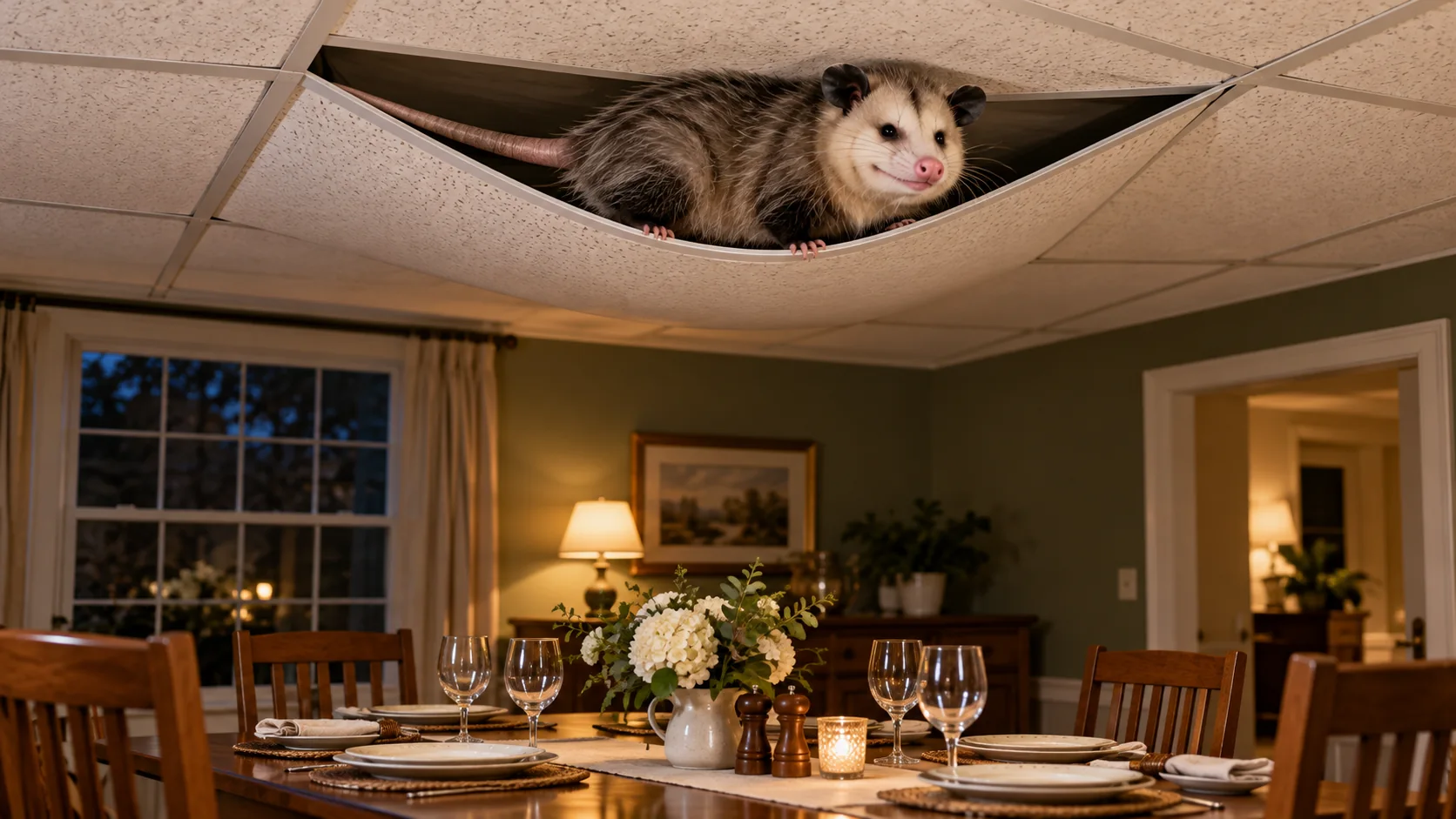
The tile tells you before your nose does. It goes soft in the middle, then quietly drops the entire argument onto your dinner table.