
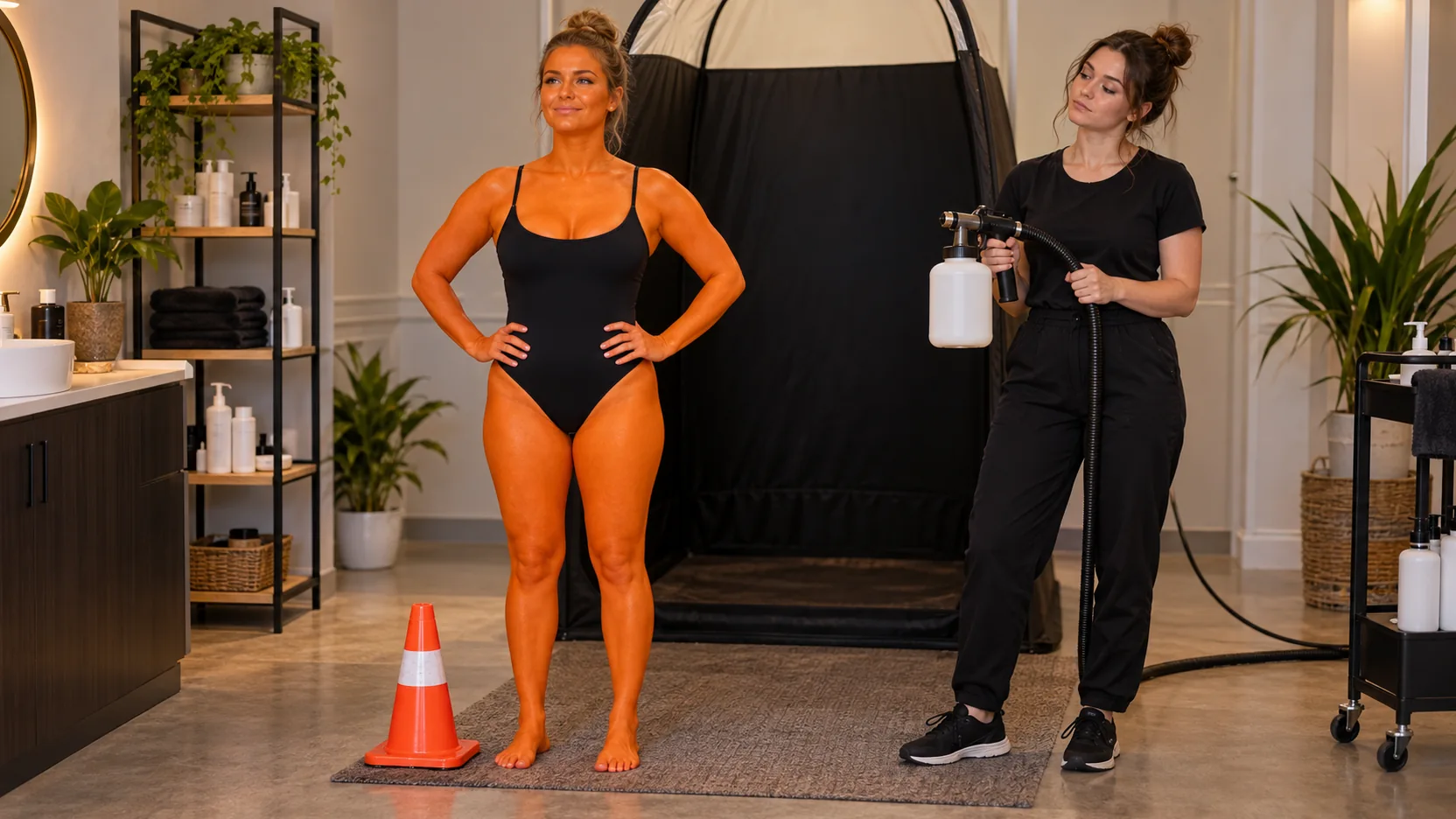
Spray Tan Warning Signs Before You Look Like a Traffic Cone
Spray tan warning signs before you look like a traffic cone show up early, usually while you are still fully clothed and still capable of leaving.
They arrive as a mystery jug and a bored technician.
They arrive as a shade chart with three settings that all sound like energy drinks.
Miss them and your skin lands on a color that legally requires a reflective collar, and neighbors start slowing down to look at your driveway.
Spotting them takes about ninety seconds, which is less time than picking the playlist.
Red flags you can spot before your pants come off
Start with the jug.
A serious solution bottle has a brand name, a stated undertone, a DHA percentage, and a batch date printed on it like an adult product made by adults.
A bad one is unlabeled and refilled from something with a spigot.
It lives in the back room next to a technician’s abandoned Monster Energy, which is where your face is about to come from.
Ventilation matters too, because the FDA has never approved DHA for all-over misting in tanning booths.
The agency wants your eyes, your lips, and your mucous membranes protected, which is a federal way of telling you to shut your mouth and clench something.
Some of this is worth walking out over.
- No consultation, no questions about your skin, just a shrug and a button labeled Ultra.
- No eye covers, no nose plugs, no lip balm anywhere in sight.
- The technician cannot name the brand loaded into the gun she is aiming at your bare ass.
- The darkest setting is described as “for the girls who like it dark,” which is not color theory, that is a dare.
The DHA number nobody says out loud
DHA is the whole tan, and concentrations run from 1% to 15%, most commonly landing somewhere between 4% and 8%, depending on how bold the chemist felt.
That number decides how loud you end up looking, which makes it the most important detail in the building and the one nobody will say out loud.
Salons announce it about as often as caterers announce calories at a wedding.
Going darker is not bravery. Dermatologists point out that more DHA buys a faster tan that runs oranger, drier, and meaner on sensitive skin.
Europe took the number seriously. Its safety committee proposed capping DHA at 10% in lotions, while the US set no limit and some formulas reach 15%.
So a jug that would get side-eyed in Brussels sits perfectly legal in a strip mall between a vape shop and a Subway, humming quietly, waiting for you and your optimism.
Orange is not an accident. It is chemistry with a preference.
Nothing in that bottle is orange.
DHA goes on clear and is a sugar compound, meaning the glow you paid sixty dollars for is a dessert reaction taking place on your torso.
It browns you through the Maillard reaction, the same browning that happens to bread and roast meat, which is why nothing about it can be rushed or negotiated.
You are being lightly toasted from the outside in, and the overnight smell is the part nobody oversells.
The catch is that DHA throws more yellow pigment than red, and cosmetic patents flatly describe the unnatural orange color it produces on skin.
Yellow poured over pale equals citrus.
That is arithmetic nobody wants performed on their face, their neck, or the four inches of chest visible in every photo taken that weekend.
The word organic on the label fixes none of it, because the yellow lean lives in the molecule rather than in the font choices on the front of the bottle.
Sixty years of getting it wrong
This has been going sideways since Coppertone released QT in 1960 as an overnight tanner and turned a generation of housewives into human Fanta.
A Cincinnati researcher spilled DHA, watched it stain skin brown, then painted it on herself.
Six decades of chemistry later, people still stand nude in a fiberglass phone booth doing a T-pose for a robot that talks to them politely.
Orange earned its day job for a reason, since it is one of the most visible colors against nearly any background.
A cone is built to be spotted from a moving car. So is your cleavage.
An industry that fat still ships a product with a built-in orange setting, then turns around and blames your elbows and your shower routine for finding it.
Your elbows are snitching
Dry skin drinks DHA like a college freshman drinks anything free.
Elbows, knees, and ankles soak up the most color, which is why the orange throws its loudest party in every place you bend.
Lotion, deodorant, perfume, and the body oil you applied for optimistic reasons all act as barriers, so what you do that morning outranks whatever the booth does later.
- Exfoliate the day before, not twenty minutes before, and skip any scrub with oil in it.
- Shave or wax a full day ahead so your pores are not open and thirsty when the mist arrives.
- Arrive bare. No lotion, no deodorant, no perfume, no shimmer, no leftovers from last night.
- Moisturize the dry spots only, meaning elbows, knees, ankles, knuckles, and nothing your imagination just volunteered.
The eight hours after are where everyone chokes
Sweat is the enemy.
Color keeps developing long after you leave, so a gym session turns your back into a topographic map of a mountain range nobody asked to visit.
Anything wet leaves a permanent editorial comment, including rain and a partner who picks that exact evening to get handsy.
Sleep in loose black clothes on sheets you have no emotional attachment to, and make peace with the fact that the pillowcase is already dead.
Already a cone? Here is the damage control
Panic scrubbing turns solid orange into patchy orange, which reads to strangers as a diagnosis.
Sunless tans usually last five to ten days, because the color is riding on dead skin cells that were leaving anyway.
Which means the cure is the same slow process that murders every tan you have ever loved, except this time you are cheering for it out loud.
- An exfoliating mitt and warm water, worked in patient rounds instead of one furious shower where you cry a little.
- A dedicated tan remover, which outperforms the lemon and baking soda paste the internet keeps pushing on desperate people.
- Color correctors, since green tones counteract orange and purple ones neutralize the yellow.
- Time. Free, boring, undefeated.
Wear the sunscreen anyway
A fake tan protects you from absolutely nothing.
Spraying still beats baking, since using a tanning bed before age 35 raises melanoma risk by 75%, which is a genuinely terrible trade.
That does not promote the booth to a health product, and sunless tanners provide no meaningful sun protection, so the SPF 30 is still your job.
Book the lightest shade, ask for the DHA percentage and the undertone before you take your clothes off, and if nobody can answer that, spend the money on lunch.


