Warning Signs Your Tattoo Artist Learned Everything from Coloring Books
The warning signs your tattoo artist learned everything from coloring books show up fast: outlines as thick as a garden hose, an eight-color palette, and pure panic whenever a design has no lines.
Catch them early, and your skin dodges the pancake-house kids’ menu look.
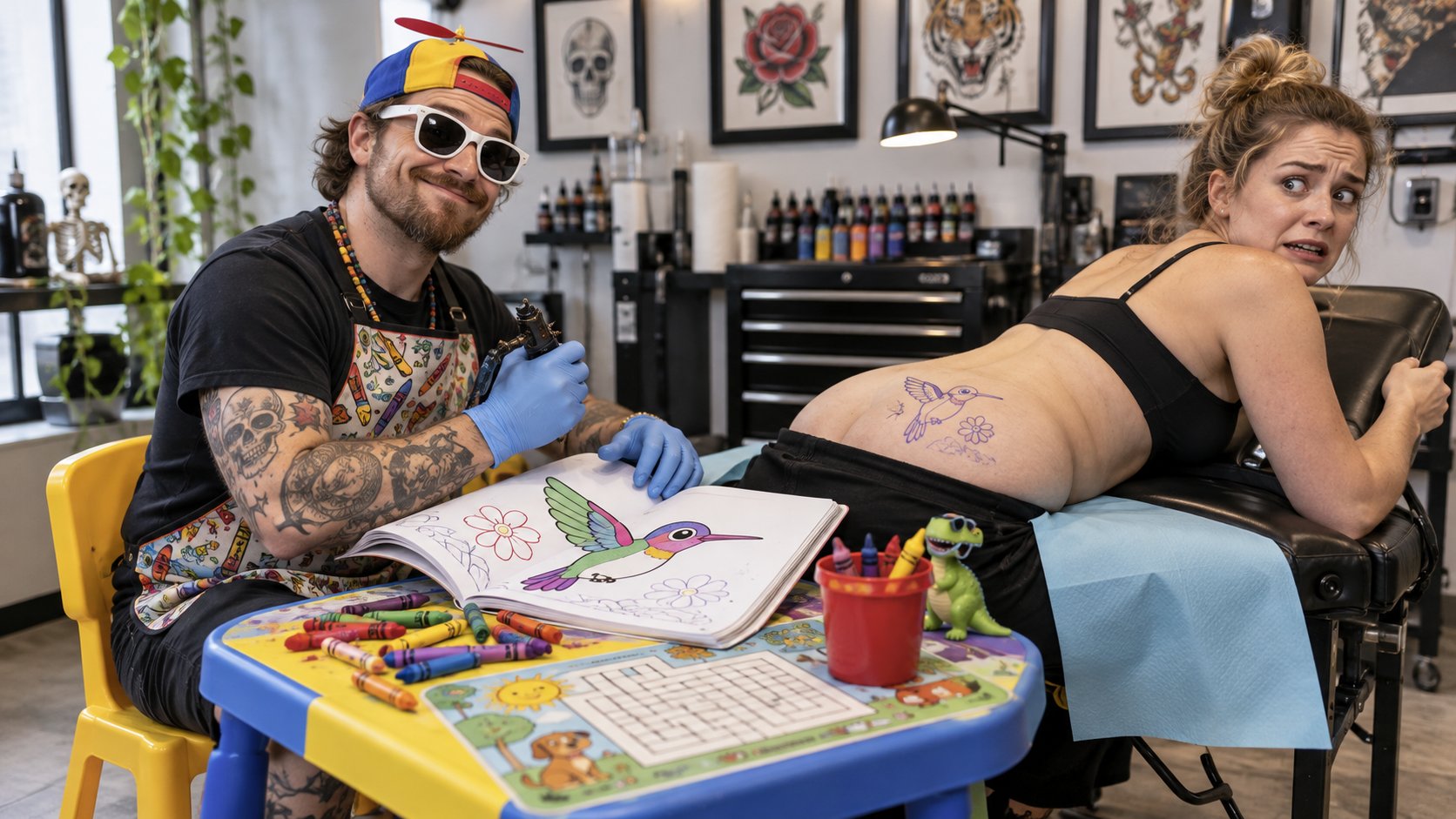
Miss them, and you’ll spend decades explaining to every new naked guest that the smudge above your butt was supposed to be a hummingbird.
Warning Signs Your Tattoo Artist Learned Everything from Coloring Books
Some red flags come with a liability waiver and a juice box.
- The consultation happens at a tiny plastic table with a cup of broken crayons and a placemat maze.
- Every custom request gets the same reply: “Is that one in the book?”
- Aftercare is a gold star sticker.
- The shop smells like Play-Doh and the particular regret of 11 p.m. on a Friday.
- They call the stencil “grown-up tracing paper” and wink at you while saying it, which is somehow the least sexy wink ever performed by a human.
- Business cards say “Est. Recess.”
Outlines You Could Hang Laundry On
Coloring-book lines are designed for toddler fists, so artists raised on them treat every outline like it owes them child support.
Medicine has a name for the damage. A case report on tattoo blowout and excessive needle pressure describes ink pushed too deep into the fat layer, leaving blurry, bruised-looking borders.
The result looks like a Sharpie hooked up with a wet paper towel and nobody used protection.
A firm hand is welcome in plenty of adult situations, but your inner arm isn’t one of them, and that report says spots like it may blow out more easily.
Ask to see fine linework before booking. If every rose in the portfolio looks like it was drawn with a tire iron, keep your sleeves down and your pants zipped.
A Palette That Fits in a Nickel Box
Crayola’s original 1903 box of eight crayon colors sold for a nickel and held red, orange, yellow, green, blue, violet, brown, and black.
Coloring-book tattooists never upgraded, so every sunset they ink is a Skittles factory fender bender.
Request “dusty mauve” and watch their soul leave their body. Their entire shading technique is pressing harder.
Taste is the smaller problem. The FDA notes that no color additives are approved for injection into skin, and some tattoo pigments are industrial grade colors suited to printers’ ink or automobile paint.
So yes, a sketchy artist can give your thigh a candy-apple finish, just not the way your mechanic pictured it while lying under a Camaro.
Put the two side by side: the nickel box was built for first graders, while some pigment headed into adult skin was built to survive a car wash and a Tulsa hailstorm.
Freehand Makes Them Sweat
Hand them blank skin and they freeze like a teenager who finally unhooked the bra with zero plan for step two.
Science backs the meltdown. In a study of 84 undergraduates coloring structured patterns, mandala and plaid colorers shed more anxiety than students coloring on blank paper.
No lines, and your artist breathes like a pug on July stairs.
Guides treat stencils like cheating. That study says structure calms whoever holds the tool.
A nervous stenciler still beats a “free spirit” improvising on your left ass cheek after two White Claws and a breakup text from someone named Tyler.
The Refrigerator Portfolio
Fridge magnets. That’s the filing system.
A legit portfolio shows healed work, because fresh ink is shiny and swollen and flattering in the same lying way bathroom-mirror selfies are flattering.
Coloring-book artists skip healed photos, since their work settles into something resembling a bruise that lost a bar fight to a highlighter.
Watch the output volume, too. Crayola makes nearly 3 billion crayons a year, and an Instagram account pumping out “originals” at factory speed is probably tracing at factory speed.
If every piece features a unicorn plus a suspicious blank patch labeled “color me,” leave before someone offers you a lollipop for being brave.
Sterile Is Not a Crayon Color
Nobody wants a souvenir that needs a prescription. A proper shop pulls needles and tubes from sealed packages and runs reused gear through an autoclave, a heat sterilizer.
A coloring-book artist keeps needles in a pencil cup beside a glue stick and half a Lunchable.
An artist who won’t glove up is a red flag in any chair or backseat.
Pricey Ink, Same Bacteria
A high price is a lousy condom. Guides love warning about cheap ink, yet an FDA study of contaminated tattoo inks found bacteria in 26 of 75 samples, including 16 of 49 labeled sterile.
Those bottles were unopened, so a boutique studio’s price tag buys a nicer playlist, not cleaner ink from the manufacturer.
Sloppy handling piles on. A CDC report on tattoo-linked mycobacterial infections counted 19 cases in one New York cluster and flagged diluting ink with nonsterile water as a known culprit.
Ask where the rinse water comes from. If the answer is “the hose out back,” pull your pants up, because the only thing getting sterilized today is your sex life.
Stack those findings: a third of inks can arrive dirty, and a careless artist can ruin the rest.
That leaves hygiene habits as the only filter a customer can check with their own two eyes, ideally while still fully clothed and at least somewhat sober.
Does a Tiny Tattoo Mean Tiny Risk?
For once in human history, size doesn’t matter.
Lund University researchers studying tattoos and lymphoma found a 21% higher risk among tattooed people, regardless of how much skin was inked.
It’s only a possible association, so keep the ankle dolphin, but “it’s just a little one” convinces nobody here or in bed.
Why Coloring-Book Artists Suddenly Exist
Blame 2015.
Nielsen reported that adult coloring book sales hit 12 million copies in 2015, up from 1 million in 2014, with 71% of buyers women and 18-to-29-year-olds the largest group.
Tattoos rode the same wave. Ipsos found 30% of Americans had a tattoo in 2019, up from 21% in 2012, with adults 18 to 34 leading at 40%.
Same young crowd, same stretch of years, and the same itch to fill blank space with something pretty.
Somewhere in that overlap, a person finished a mandala book on Tuesday and ordered a tattoo machine online Wednesday. That person now has a gel-pen waiver and glowing reviews from Mom.
The Regret Bill
Pew Research found that 32% of U.S. adults have a tattoo, and 24% of those inked adults regret at least one.
Multiply those, and roughly 1 in 13 American adults carries art they wish would vanish faster than a Tinder date when the check lands.
Removal is where the comedy stops being cheap. According to the American Society of Plastic Surgeons, the average cost of laser skin treatments like tattoo removal is $697, covering only the surgeon’s fee.
That bargain flash special from the guy with Elmer’s glue on his apron becomes the priciest one-night stand of your life.
Before the Needle Touches Skin
Run these checks before you drop your pants or your standards.
- Call the city or county health department and confirm the shop holds a license.
- Watch the needle come out of a sealed package with your own eyes.
- Healed photos. Non-negotiable.
- Ask what ink brand they use, and if the answer involves “the big box with the sharpener in the back,” run like the fire alarm went off.
Then stare at the linework one more time. If it looks like something your nephew traded you for a juice pouch, book a consultation somewhere that keeps the crayons in the waiting room.