Budget Decorating Ideas for the Shed You’re Calling a Guesthouse
The best budget decorating ideas for the shed you’re calling a guesthouse come down to a real mattress, blackout curtains, free paint, thrifted furniture, and warm light.
Spend on sleep and safety first. Everything else is lipstick on a riding mower.
A shed guesthouse is a backyard outbuilding with a bed, a light, a locking door, and enough charm that your mother-in-law won’t call it “the shed.”
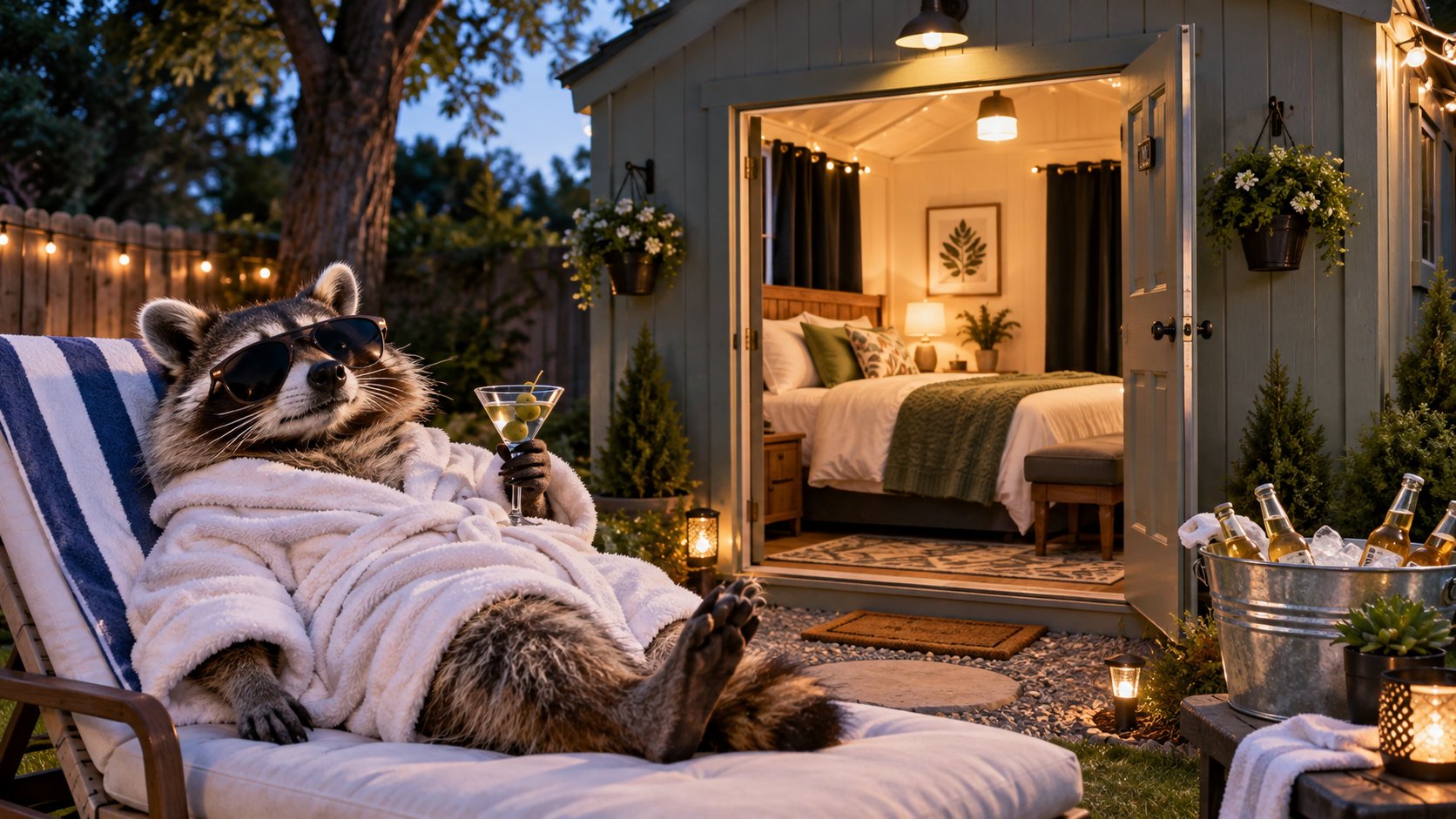
She’ll call it the shed anyway, so aim for a room that feels like a boutique hotel for three nights, then slowly starts feeling like the place where raccoons go to hook up.
The $160 hotel problem
U.S. hotels charged an average daily rate of $160.54 in 2025. Wave that at any brother-in-law whining about the weed whacker.
Americans put up with houseguests for an average of six days, in-laws get five, and 22% of hosts will flat-out tell a guest to leave, per a 2025 Talker Research survey.
Five nights of in-laws at hotel prices runs roughly eight hundred bucks.
The shed keeps that cash in your pocket. It also keeps the in-laws out of the upstairs hallway at 2 a.m., where nobody needs to hear what a marriage sounds like.
Cozy, but not too cozy
Most shed-conversion advice says to make guests feel completely at home.
Terrible plan. Guests who feel at home start getting mail there.
Decorate for three glorious nights. Cozy enough to brag about at brunch, but never so cozy that Todd sets up a standing desk and calls the compost bin “the ensuite.”
Plenty of households don’t even have a guest room. A shed with a real door already beats a pull-out couch with a stain shaped like Ohio.
The walls
Shed walls block sound about as well as a shower curtain. That becomes everyone’s problem the second a visiting couple decides the garden is romantic.
Put a box fan in there for white noise. The cul-de-sac will thank you.
Budget Decorating Ideas for the Shed You’re Calling a Guesthouse
Most of the budget belongs directly under the guest’s back. Nobody has ever left a glowing review for a throw pillow.
Mattress first, macramé never
A thrifted headboard can’t save a futon that folds a grown man in half like a sad taco.
Buy the mattress new.
Used mattresses come with a history, and that history is always a little sticky.
On a tight budget, put a memory foam topper over an old guest bed.
It remembers everything, which is more than Uncle Ray can say after four Coors Lights and the hot tub incident.
Add two pillows per person, sheets that have never met the dog, a spare blanket, and a comforter heavy enough to pin down any guest who wants to “help” with breakfast.
Blackout curtains, or everybody’s up at 5 a.m.
Light is the enemy. In a sleep study spotlighted by the National Heart, Lung, and Blood Institute, one night under overhead room lighting raised heart rate and insulin resistance the next morning.
That makes the humble blackout curtain more valuable than every GATHER sign on Pinterest.
A cheap tension rod and two dark panels do more for a guest than a whole wall of reclaimed barn wood that still smells faintly of barn.
Blackout panels also stop the neighbors from seeing whatever your college roommate does out there after midnight. Some things should stay between a man and his sleeping bag.
Free paint from somebody else’s bad decisions
About 10% of all paint bought in the U.S. goes unused, around 64 million gallons a year, according to EPA estimates cited by Connecticut regulators.
That’s a lot of half-empty cans of “Seductive Sage” rotting in garages.
Ask the neighbors. They’re desperate to get rid of the color that almost ended their marriage.
Free paint does have a catch in a room the size of a walk-in closet. The EPA says several organic compounds average 2 to 5 times higher indoors than outdoors.
A sealed shed is the most indoors place on earth, so paint days before the guests arrive and leave the door wide open.
Otherwise Grandma wakes up high and describes, with hand gestures, the Fleetwood Mac concert where she “made some friends.”
Light colors make a shed look bigger. Dark colors make it look like the place where somebody keeps a sex swing next to a chest freezer.
Thrifted furniture
Americans generated 12.1 million tons of furniture waste in 2018, landfilling about 9.68 million tons and recycling only about 40,000.
Translation: decent nightstands die on curbs every weekend, and nobody even holds a funeral.
Hit Habitat for Humanity ReStores, yard sales, church rummage sales, and Facebook Marketplace.
Estate sales are the sweet spot. The previous owner is definitely not coming back for that dresser.
Sniff everything before it goes in the car. A dresser can hide the ghost of ten thousand Marlboros.
A used recliner can hide far worse. Nobody wants to know what happened in a used recliner, least of all the guest who has to sit in it.
The nightstand
Guests snoop. In a 2022 OnePoll survey for Serta Simmons, a quarter of guests admitted they’d dig through the nightstand, including 30% of Gen Zers and 16% of boomers.
Boomers snoop less because they already know what’s in there and would rather not see it again.
Clean the drawer out completely.
Stock a phone charger, a flashlight, earplugs, and a card with the Wi-Fi password.
Do not leave the fuzzy handcuffs or the family-size bottle of lube from your “experimental” year.
They’ll surface at Easter, loudly, in front of the pastor and your nephew’s new girlfriend.
The bathroom situation
Most sheds don’t have one, and guests notice fast.
Leave a flashlight by the door and light the path to the house with solar stakes.
Otherwise a 70-year-old man in saggy boxers will be peeing on your hydrangeas at 4 a.m.
He will make eye contact with the neighbor. The neighbor will never recover.
Warm light that forgives everything
String lights make anything look sexy, including a shed that stored a riding mower until last Tuesday.
Go with LED bulbs. ENERGY STAR certified LEDs use at least 75% less energy and last up to 25 times longer than old incandescents.
That matters when the whole shed runs off one tired orange cord.
Pick warm white. Cool white makes the room look like a gas station bathroom, and nobody’s getting lucky in a gas station bathroom. Nobody classy, anyway.
A few more cheap upgrades pull serious weight in a tiny room:
- A hook rack by the door, because a guest with nowhere to hang a wet towel will hang it on your chainsaw.
- Peel-and-stick wallpaper on one wall.
- A big mirror, which makes small rooms look larger and guests look hotter, and that trick is the entire business model of every nightclub in America.
- A rug over the plywood so nobody gets a splinter somewhere awkward.
- Snacks, water, and a spare toothbrush for the cousin who “forgot” his again (he never owned one).
- A lock. Inside only, please.
Hide the tools, too. A pegboard of clamps and hedge trimmers over the bed says “this is where the podcast episode starts,” so throw a curtain over it and call it texture.
Is the shed legally a bedroom?
Maybe not. The International Residential Code requires habitable rooms of at least 70 square feet, no side under 7 feet, and ceilings at least 7 feet high.
Plenty of prefab sheds miss one of those, usually the ceiling.
That’s how a tall guest ends up with a concussion and a new appreciation for kneeling, which, to be fair, some guests already had.
Local rules vary wildly, and a model code is only the starting point. Call the building department before anyone sleeps out there, especially if money will change hands.
A proper sleeping room also needs a way out in an emergency.
A shed with one tiny window and a padlock on the outside isn’t a guesthouse. It’s the first ten minutes of a true-crime documentary.
Heaters and carbon monoxide
Space heaters get cocky.
The CPSC says to keep heaters at least three feet from bedding, drapes, and furniture. It tied space heaters to about 9,900 home fires and 190 deaths a year in 1999-2002.
Now do the shed geometry.
A code-minimum room is 7 feet wide, and a full-size mattress eats about four and a half of those feet. That leaves two and a half feet for a heater that needs three.
That missing six inches (a phrase plenty of people have heard in a bedroom before) is exactly how Aunt Carol loses her eyebrows.
Stop plugging a space heater into the dollar-store extension cord that’s lived in a Folgers can since the Clinton administration.
Plug it straight into the wall, or buy an oil-filled radiator and quit gambling with people’s faces.
Carbon monoxide
Anything that burns fuel near the shed calls for a carbon monoxide alarm inside it.
The safety gear costs less than one fancy lantern set, and it’s the only decor that can keep someone alive:
- A battery-powered carbon monoxide alarm.
- A smoke alarm, tested with the button instead of with bacon.
- A small fire extinguisher mounted by the door, where a panicking in-law can find it without reading glasses.
Buy all of it before the lanterns.
Never run a propane heater in a closed shed, unless the plan is a nap with no sequel.
Mice, mold, and that smell
The mice got there first. They’ve been having more sex in that shed than anyone in the main house has had since the second kid.
Clean up after them the CDC way: air the place out for 30 minutes, skip the broom and vacuum, and soak droppings in 1.5 cups of bleach per gallon of water.
Sweeping mouse poop tosses hantavirus into the air. Nothing kills a romantic weekend faster than a rare lung disease named after a river in Korea.
Stuff every gap with steel wool.
Then have a firm talk with the cat about job performance, because the cat has clearly been phoning it in.
Moisture is the next villain. The EPA recommends indoor humidity between 30% and 50%, and drying anything wet within 24 to 48 hours.
A cheap hygrometer shows the number. A small dehumidifier fixes it.
Skip both and guests wake up smelling like a gym bag that just went through a nasty divorce.
Keeping cool without central air
Fans work. Research compiled for the Department of Energy says a ceiling fan lets the thermostat rise up to 4°F with no noticeable comfort loss, and each degree cuts cooling energy 10% to 15%.
Pair a small window unit with a ceiling fan, and a sheet-metal sauna turns humane.
Without them, the guest sweats through the sheets, and everybody at breakfast assumes something far more interesting happened out there. Keep the blackout curtains shut during the day, too.
Airbnb money can wait
Hold off on listing it. The typical U.S. Airbnb host earned about $15,600 in 2025, according to the company.
That’s about 97 hotel nights at the 2025 average, and it shows who the competition is. Paying strangers compare the shed to a hotel room with a real toilet.
A shed with a bucket labeled “EMERGENCY ONLY” will not collect five stars.
Strangers also write reviews. Aunt Linda only writes passive-aggressive Christmas cards, so start with family, fix whatever they whine about, and think about charging once nobody mentions the bucket.
One test night
Sleep out there before anyone else does. Kill the lights, listen for mice, sniff the air at 3 a.m., and check whether the neighbor’s motion light hits the pillow.
Test the Wi-Fi from the pillow, too. A guest with no signal will come knocking on the back door at midnight.
Bring a partner to test the soundproofing properly. Then take the neighbors a bottle of wine and order the thicker curtains.