
Last Updated on April 24, 2025 by Michael
Bizarre Wildlife: Extraordinary Facts About Earth’s Strangest Creatures
Ever wondered what happens when Mother Nature gets bored and decides to make animals that look like they were designed after a three-day energy drink bender?
Wonder no more! Here’s your ultimate guide to some of the weirdest creatures on the planet that somehow made it through evolution’s quality control department.
These weird animals aren’t just freaky photo opportunities—they’re walking, swimming, crawling proof that evolution has a wicked sense of humor and possibly access to hallucinogens.
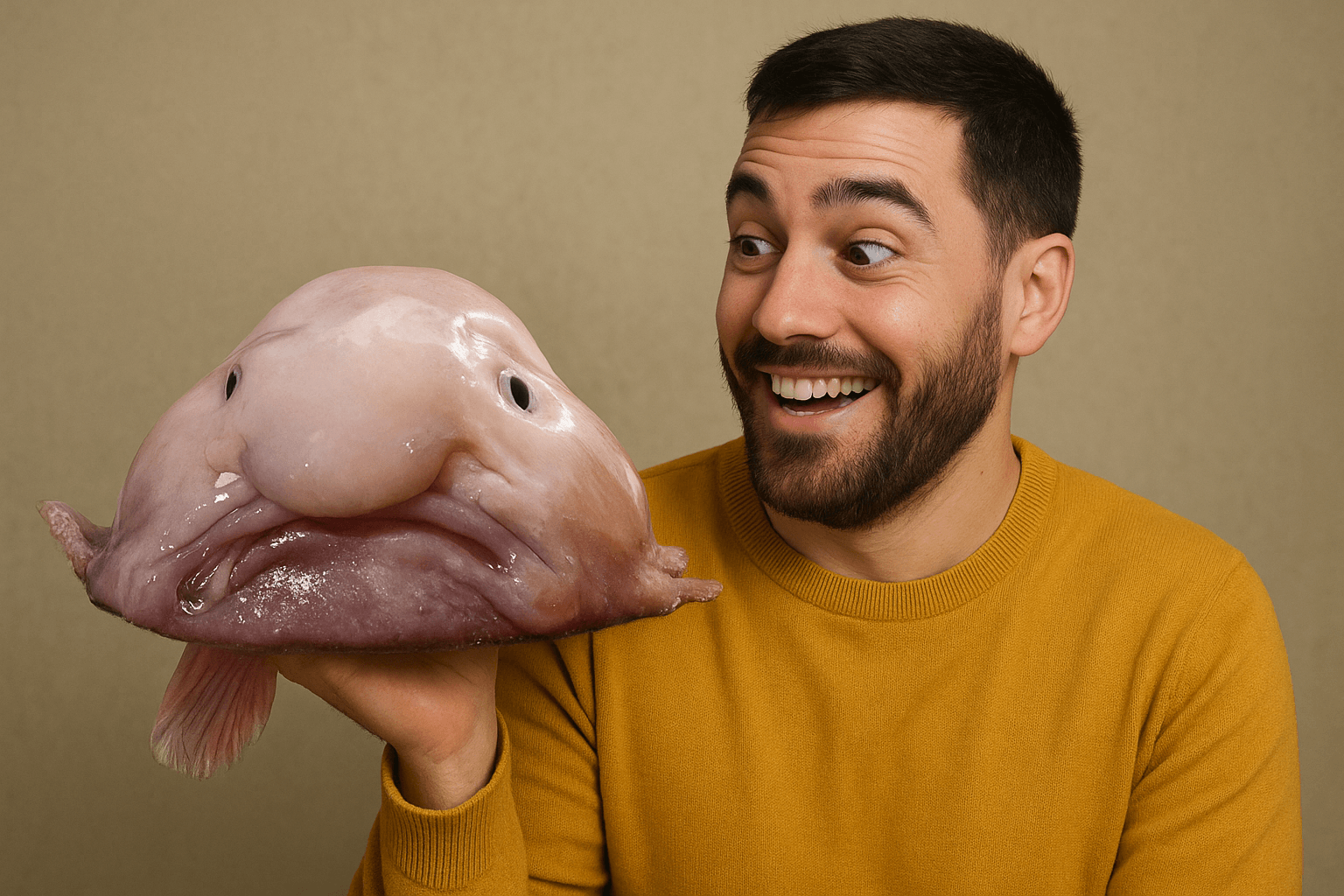
The Blobfish: Depression With Fins
Look, we all have bad hair days, but the blobfish has a bad everything day… every single day.
When chilling in its natural deep-sea habitat (up to 4,000 feet below sea level), this gelatinous wonder looks somewhat normal. But bring it to the surface, and BOOM—instant melting nightmare fuel!
The pressure change transforms it into what looks like a sad, deflated balloon with a face that screams “I’ve made terrible life choices.”
Fun fact: The blobfish was voted “World’s Ugliest Animal” in 2013. Not a great achievement to put on your underwater resume, but hey, at least it’s famous for something!
You might be wondering: “What does this exotic creature do all day?”
Absolutely nothing. The blobfish’s entire lifestyle philosophy is “why swim when you can just… exist?” It floats above the ocean floor letting edible particles drift into its mouth. Talk about peak laziness goals!
The blobfish is also a master of energy conservation—using almost zero energy to maintain its position in the deep sea. While you’re at the gym struggling on the StairMaster, this blob is effortlessly hovering in the depths, winning at life with minimal effort.
Help the blobs: Despite their amusing appearance, blobfish face threats from deep-sea trawling. Support sustainable fishing practices and marine protected areas to help these bizarre blobs survive.
The Aye-Aye: Nature’s Goth Nightmare
Half bat, half nightmare fuel, the aye-aye of Madagascar takes the cake for “Animal Most Likely To Be Mistaken For A Tim Burton Character.”
Some quick facts about this bizarre primate:
- Has a freakishly long middle finger used for tapping trees to find grubs
- Possesses enormous ears that would make Dumbo jealous
- Sports continuously growing incisors like rodents
- Glowing orange eyes that scream “I’m coming for your soul at 3 AM”
- Lives primarily in rainforest canopies
- Can rotate its ears independently to triangulate sounds
In Madagascar, locals believe seeing an aye-aye means:
- Death is coming
- Bad luck forever
- You should probably just move to another village
- Your crops will fail
- Your future children will have strange features
Which explains why these unique wildlife creatures are endangered. Nothing says “conservation challenge” like an animal that looks like it might curse your family for seven generations!
Save the spooky primates: Support Madagascar rainforest conservation efforts that protect the aye-aye’s natural habitat and promote educational programs to change local superstitions.
The Star-Nosed Mole: When Evolution Says “More Tentacles!”
The star-nosed mole proves that even Mother Nature occasionally thinks, “You know what would improve this perfectly normal mammal? A cosmic horror face!”
This subterranean oddball sports a snout surrounded by 22 fleshy appendages that make it look like it’s wearing a tiny pink starfish as a nose.
Don’t be fooled by its Lovecraftian appearance—this bizarre schnoz is actually a superpower!
| Star-Nosed Mole Ability | Scientific Reality |
|---|---|
| Can identify and consume food in 120 milliseconds | Fastest mammalian forager on Earth |
| Nose contains 100,000+ nerve fibers | Six times more touch sensors than human hand |
| Can smell underwater by blowing air bubbles | Only mammal with this specialized skill |
| Each tentacle works independently | Processes environmental data in parallel |
The star-nosed mole lives underground in wetlands, where it tunnels through mud with remarkable efficiency and precision.
Protect these weird nose wizards: These wildlife curiosities serve as bioindicators for wetland health. By monitoring their populations, you can gauge the ecological state of these vital habitats.
Next time you’re having a bad hair day, just remember—at least you don’t have 22 wiggling appendages on your nose!
The Naked Mole Rat: Fashion’s Greatest Failure
Bold statement: The naked mole rat is what happens when nature decides to create an animal using only leftover parts.
These underground dwellers from East Africa look like someone took all the cute parts off a regular rat and replaced them with wrinkly skin, giant teeth, and tiny, useless eyes.
Seriously, these things are so ugly they circle back to adorable, like a pug that’s been left in the bath too long.
But don’t judge this book by its hairless cover! Naked mole rats are superheroes without capes.
Ever wondered how these wrinkled wonders survive in the harsh underground environment? Their adaptations are nothing short of miraculous:
- Feel no pain (they lack the neurotransmitter that signals pain from acid burns)
- Live 10 times longer than similar-sized rodents
- Almost never get cancer
- Can survive with almost no oxygen for 18+ minutes
- Live in underground colonies with a queen, like bees but way more disturbing to look at
- Can move their teeth independently like chopsticks
Make a difference for these wrinkly wonders: Scientists study naked mole rats for cancer prevention and longevity research. Support organizations that responsibly research these remarkable adaptations for human health applications.
You know how they say beauty is only skin deep? Well, these guys said “forget skin altogether” and focused on becoming practically immortal instead. Smart move!
The Tarsier: When Your Eyes Are Bigger Than Your Future
Your eyes might be the windows to your soul, but a tarsier’s eyes are more like bay windows to a very nervous, caffeine-addicted soul.
These tiny primates from Southeast Asia have eyes so enormous they can’t move them in their sockets.
How do they look around? They rotate their entire head nearly 180 degrees like a furry, bug-eyed owl with an espresso addiction.
Some mind-blowing tarsier truths:
- Each eyeball is approximately the same size as its brain
- They’re the only 100% carnivorous primates
- Can leap over 40 times their body length
- Makes calls at such high frequencies humans can’t hear them
- Smallest living primate with enormous eyes relative to body size
- Can capture insects mid-air with precision jumps
The most shocking thing about tarsiers? They’re actually related to humans! That’s right—this strange little gremlin with satellite dish eyes is your distant cousin. Maybe don’t mention this at your next family reunion.
Stand up for bug-eyed buddies: All tarsier species face threats from habitat loss and hunting. You can support conservation by avoiding wildlife tourism that disturbs these sensitive creatures and by contributing to Southeast Asian forest preservation efforts.
The Platypus: Evolution’s Practical Joke
When the animal design committee had their end-of-year party, someone clearly got drunk and assembled the platypus as a dare.
“What if we take a beaver, add a duck bill, make it lay eggs, and—wait for it—make it VENOMOUS?”
The platypus breaks so many rules of nature it might as well be wearing a “I don’t play by your rules” t-shirt:
- Mammals lay eggs? Nope! Except the platypus does.
- Mammals don’t have venomous spurs? The platypus didn’t get that memo.
- Animals should either have bills OR fur, not both? Platypus: “Hold my beer.”
- Most creatures detect prey with eyes or ears? This rebel uses electroreception to find food underwater with its eyes CLOSED.
- The only mammal that glows under UV light with biofluorescent fur
When European naturalists first received a platypus specimen, they thought it was a hoax—someone had sewn different animal parts together as a prank.
These wildlife curiosities continue to baffle and amaze scientists even today. The question remains: was evolution just messing with us?
Join Team Duck-Beaver: These extraordinary creatures face threats from water pollution and habitat degradation. You can help by supporting Australian waterway protection initiatives and reducing your use of chemicals that end up in aquatic ecosystems.
The Axolotl: Permanent Teenage Phase
Most amphibians grow up, lose their gills, and leave the water. The axolotl said “nah” and decided to stay in its adolescent phase forever.
These Mexican salamanders never mature, keeping their feathery external gills and aquatic lifestyle their entire lives.
It’s like that 30-year-old who still lives in their parents’ basement, except much cuter and with superhero regeneration powers.
Speaking of which—axolotls can regrow almost anything:
- Limbs? No problem.
- Parts of their heart? Easy peasy.
- Spinal cord? Give them a few weeks.
- Portions of their brain? Sure, why not!
- Entire jaw structure? They’ll have it back by Tuesday.
- Damaged organs? Just a temporary inconvenience.
While humans get excited about growing a fingernail back, these aquatic Peter Pans are out here casually regenerating vital organs.
Can you imagine if people could do this? “Sorry I’m late for work, had to regrow my arm after that unfortunate blender accident.”
Be a hero for these living cartoons: Critically endangered in the wild, axolotls are studied for their remarkable regenerative abilities. Support conservation efforts for Lake Xochimilco in Mexico and resist the urge to get one as a pet unless you’re committed to proper specialized care.
Speaking of animals with special powers, let’s meet the walking tank of the mammal world…
The Pangolin: Nature’s Walking Pinecone
Meet the pangolin: the only mammal completely covered in scales, looking like an artichoke with legs.
These strange creatures walk on their hind legs like tiny dinosaurs and use their sticky tongues to slurp up ants and termites.
How long is that tongue, you ask? Up to 16 inches—longer than their entire body! It’s attached not to their mouth but to their pelvis. Talk about evolutionary overachievement.
When threatened, pangolins don’t run—they curl into a tight ball of “nope,” using their razor-sharp scales as armor. Predators are left scratching their heads, wondering how to eat what is essentially a living pinecone with trust issues.
They’re like the medieval knights of the animal kingdom—if knights were shy, ant-eating oddballs who could roll up like a basketball when scared.
Other bizarre pangolin facts:
- No teeth—they swallow stones to grind food in their stomachs
- Can consume up to 70 million insects yearly
- Scales made of the same material as human fingernails
- Give birth to just one baby pangopup at a time
- Can close their ears and nostrils to keep ants out
Become a pangolin defender: These weird animals are the most trafficked mammals in the world. You can help by supporting anti-poaching efforts and spreading awareness about the illegal wildlife trade threatening their existence.
Conclusion: Nature’s Weirdest Flex
What have we learned from this journey through evolution’s experimental phase?
Mother Nature has a sense of humor weirder than your uncle’s Facebook memes.
While humans worry about having a bad hair day, somewhere out there a blobfish is looking like melted ice cream with depression, and a star-nosed mole is trying to decide which of its 22 nose-fingers to pick its nose with.
So next time you’re feeling a bit strange or out of place, remember—you could be a naked mole rat. Things could always be worse!
Support wildlife curiosities and unique wildlife conservation. After all, a planet without weird animals would be like a comedy club without jokes—technically functional, but what’s the point?
Recent Posts
So you clicked this link. That tells us everything. Somewhere in that nicotine-soaked brain, there's a tiny survivor waving a white flag, begging for mercy. Maybe it's time to listen to that...
Nobody handed you a rulebook when you walked in. There's no orientation video. No pamphlet titled "So You've Decided to Stop Being a Disaster: A Beginner's Guide." You just showed up, grabbed some...