
Last Updated on June 2, 2024 by Michael
Ah, the art of pretending to pay attention. It’s a skill that we all need to master at some point in our lives, whether we’re stuck in a boring meeting, listening to a friend’s endless story, or trying to feign interest in our partner’s latest hobby. But fear not, dear reader! I’m here to share with you some top-secret tips for fooling everyone into thinking you’re the most attentive person in the room.
The Importance of Eye Contact (Or the Illusion of It)
First and foremost, let’s talk about eye contact. It’s the key to convincing anyone that you’re hanging on their every word, even if you’re actually thinking about what you’re going to have for lunch. Here are a few foolproof techniques:
- The “Unblinking Stare”: This one’s a classic. Simply lock eyes with the speaker and don’t look away, no matter how much your eyes start to water or how badly you need to blink. Bonus points if you can do this without looking like a serial killer.
- The “Thoughtful Squint”: Narrow your eyes slightly and tilt your head to the side, as if you’re deeply pondering the words being spoken. This works especially well if you’re wearing glasses, as you can pretend to be studying the speaker over the rims.
- The “Nodding Dog”: You know those novelty toys that sit on car dashboards and nod their heads incessantly? Channel your inner nodding dog and bob your head up and down at regular intervals. Just be careful not to overdo it, or you might end up with whiplash.
If all else fails, just invest in a pair of those googly eye glasses. No one will be able to tell where you’re looking, and you’ll provide endless entertainment for everyone around you.
Master the Art of the “Mmhmm”
When it comes to pretending to pay attention, verbal cues are just as important as nonverbal ones. And there’s no sound more versatile than the humble “mmhmm.” Here are a few variations to try out:
- The “I’m Totally Agreeing with You” Mmhmm: This one’s perfect for when you have no idea what the other person just said, but you want to seem like you’re on board. Simply nod your head and let out a long, drawn-out “mmhmmmm.”
- The “I’m Deep in Thought” Mmhmm: If you want to seem like you’re really pondering the speaker’s words, try a shorter, more staccato “mmm” followed by a thoughtful pause and then a decisive “hmm.”
- The “I Have No Idea What You Just Said But I’m Going to Pretend I Did” Mmhmm: This one’s a bit trickier, but with practice, you’ll master it in no time. Combine a series of short “mmm”s with some strategic head tilts and thoughtful squints, and voila! You’ll look like you’re fully engaged, even if you’re mentally planning your weekend getaway.
Of course, if you really want to up your game, you can always throw in a well-timed “ah” or “I see.” Just don’t go overboard, or you might come across as a malfunctioning robot.
The Power of the Paraphrase
Okay, so you’ve mastered the art of the nonverbal cue and the strategic “mmhmm.” But what happens when the speaker actually asks for your input? Don’t panic! Simply employ the power of the paraphrase. Here’s how it works:
- Wait for the speaker to finish their thought.
- Repeat back the last few words they said, but in a slightly different order.
- Add a vague qualifier like “interesting” or “good point.”
- Sit back and bask in the glow of your own genius.
For example, if the speaker just said, “I think we need to focus on increasing our social media presence,” you might respond with something like, “Social media presence…increasing our focus. Interesting point.” See? It’s foolproof!
If you really want to impress, try throwing in a fancy word or two. “Ah yes, social media presence. Quite the conundrum we’re facing in this digital age.” Just don’t go overboard, or you might end up sounding like a pretentious English professor.
Embrace the Power of the Non Sequitur
Sometimes, despite your best efforts, you might find yourself completely lost in a conversation. Maybe you zoned out for a minute (or twenty), or maybe the topic is just way over your head. In these situations, it’s time to embrace the power of the non-sequitur. Here are a few examples:
- “Speaking of marketing strategies, did you know that the average person has over 100,000 miles of blood vessels in their body? The more you know!”
- “Ah yes, quarterly reports. You know, I once met a man who claimed to be able to communicate with squirrels. He was surprisingly well-adjusted.”
- “I see your point about the budget, but have you ever wondered what it would be like to live on the moon? I bet the view would be incredible.”
The key here is confidence. If you say it with enough conviction, people will be too confused to question you. And who knows? You might just steer the conversation in a more interesting direction.
The Art of the Strategic Bathroom Break
When all else fails, there’s always the strategic bathroom break. This one’s a classic for a reason – it’s the perfect way to escape a boring conversation without arousing suspicion. Here are a few tips:
- Wait for a lull in the conversation.
- Casually mention that you need to “step out for a moment.”
- Leave the room with a purposeful stride.
- Hide in the bathroom for as long as socially acceptable.
Depending on the length of the conversation, you may need to take multiple bathroom breaks. Just be sure to space them out evenly, or people might start to think you have a bladder problem.
Of course, if you really want to commit to the bit, you can always come back from your bathroom break with a new accessory, like a piece of toilet paper stuck to your shoe or a damp spot on your shirt. It’s a surefire way to distract from the fact that you weren’t paying attention.
The Importance of Props
If you really want to sell the illusion of attentiveness, it’s time to invest in some props. Here are a few must-haves:
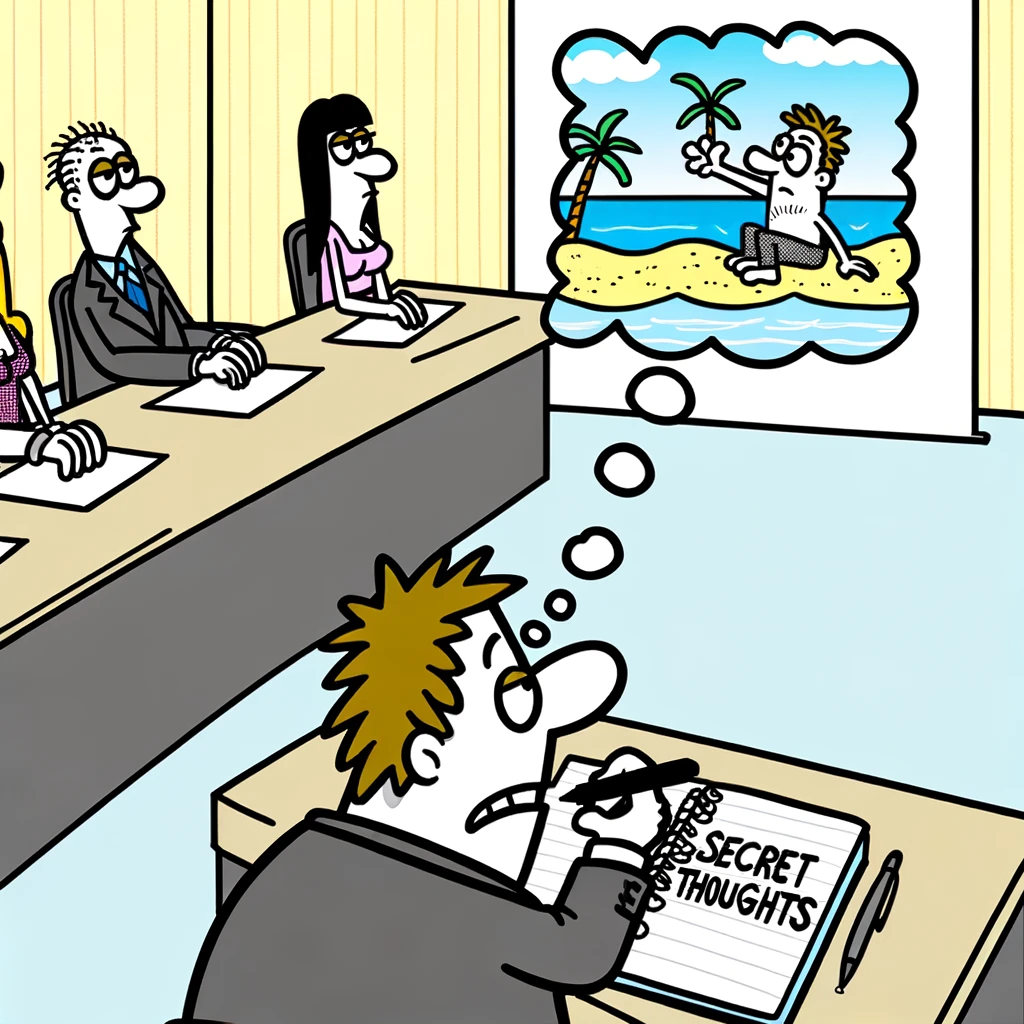
- A notebook and pen: Nothing says “I’m totally engaged” like furiously scribbling notes during a meeting. Of course, you don’t actually have to write anything relevant. Feel free to doodle, make grocery lists, or write your novel. Just make sure to nod thoughtfully every once in a while.
- A tape recorder: This one’s a bit more advanced, but if you really want to commit to the bit, invest in a tape recorder. Whenever someone starts talking, casually pull it out and hit record. Bonus points if you ask them to speak directly into the microphone.
- A fake phone: If you’re really desperate to escape a conversation, pretend to get an important call on your fake phone. Simply hold it up to your ear, nod seriously, and mouth words like “I’ll be right there” or “Don’t worry, I’ll handle it.” Then, make a hasty exit while apologizing profusely.
Of course, these props are just the beginning. Feel free to get creative and come up with your own attention-enhancing accessories. The sky’s the limit!
The Power of the Pivot
Sometimes, even the most skilled attention-pretenders find themselves in a conversation that just won’t end. When this happens, it’s time to employ the power of the pivot. Here’s how it works:
- Wait for a lull in the conversation.
- Casually mention a completely unrelated topic.
- Act like it’s the most natural transition in the world.
For example, if you’re stuck in a conversation about the latest budget report, you might say something like, “Speaking of numbers, did you know that the average person has over 100,000 hairs on their head? It’s quite fascinating, really.”
The key here is to make the pivot as smooth as possible. Don’t just blurt out a random fact – find a way to connect it to the current conversation, even if the connection is tenuous at best.
If all else fails, just start talking about the weather. It’s the ultimate conversation pivot, and it works in any situation.
The Art of the Exit
Okay, so you’ve tried all the tricks in the book, but the conversation just won’t end. It’s time to make a graceful exit. Here are a few tried-and-true techniques:
- The “Well, I don’t want to monopolize your time” exit: This one’s perfect for when you’re talking to someone who just won’t stop talking. Simply wait for a pause in the conversation, then say something like, “Well, I don’t want to monopolize your time. I’m sure you have plenty of other people to talk to.” Then, make a quick exit before they can object.
- The “Oh, I think I see my friend over there” exit: This one’s a classic for a reason. Simply pretend to spot a friend across the room, then make a hasty exit while waving apologetically. Of course, if you’re at a party where you don’t know anyone, you might have to get creative. Try pretending to see a long-lost cousin or a celebrity doppelganger.
- The “I have to go feed my pet rock” exit: If all else fails, just make up a ridiculous excuse and run with it. The more absurd, the better. “I’m so sorry, but I just remembered that I have to go water my cactus collection” or “Oh my gosh, I totally forgot that I have a Zoom call with the Pope in five minutes” are both excellent options.
Whatever exit strategy you choose, the key is to commit to it fully. Don’t hesitate or apologize – just make a confident, decisive exit and don’t look back.
The Importance of Practice
Pretending to pay attention is a skill that takes time and practice to master. Don’t be discouraged if you don’t get it right away – even the most seasoned attention-pretenders had to start somewhere. Here are a few tips for honing your skills:
- Start small: If you’re new to the art of pretending to pay attention, start with short conversations and work your way up to longer ones.
- Enlist a friend: Find a trusted friend or family member and practice your attention-pretending skills on them. Ask for feedback and adjust your technique as needed.
- Embrace your inner actor: Pretending to pay attention is all about selling the illusion. Channel your inner actor and really commit to the role.
- Don’t be afraid to fail: Even the most skilled attention-pretenders have off days. If you find yourself slipping up, don’t beat yourself up about it. Just take a deep breath, regroup, and try again.
With enough practice and dedication, you’ll be a master attention-pretender in no time!
In Conclusion
Well, there you have it, folks – the ultimate guide to pretending to pay attention. Whether you’re stuck in a boring meeting, trapped in an endless conversation, or just trying to survive a family dinner, these tips and tricks will help you fool everyone into thinking you’re the most attentive person in the room.
Of course, it goes without saying that actually paying attention is always the best policy. But let’s be real – sometimes, it’s just not possible. In those moments, it’s okay to fake it until you make it.
So go forth, my dear readers, and embrace the art of pretending to pay attention. And if all else fails, just remember – there’s always the strategic bathroom break. Happy pretending!
I'm a human being. Usually hungry. I don't have lice.
Recent Posts
So you clicked this link. That tells us everything. Somewhere in that nicotine-soaked brain, there's a tiny survivor waving a white flag, begging for mercy. Maybe it's time to listen to that...
Nobody handed you a rulebook when you walked in. There's no orientation video. No pamphlet titled "So You've Decided to Stop Being a Disaster: A Beginner's Guide." You just showed up, grabbed some...