How to Get a Job at McDonald’s
The Ultimate Guide to Faking Your Way Into a McDonald’s Job
How to Get a Job at McDonald’s
Getting a job at McDonald’s isn’t for the faint-hearted. It requires cunning, a sprinkle of self-respect erosion, and a genuine love for fluorescent lighting. Let’s be real, though: this isn’t about climbing the corporate ladder. This is about getting your foot in the door so you can access fries that fell on the floor but are still within the 5-second rule. It’s about life, liberty, and pursuit of an employee discount. If that doesn’t inspire you to fill out an application, I’m not sure what will.
Let’s get into it, you burger-hungry bandits. Here’s your complete guide to getting that job at McDonald’s.
Forget Your Dreams, It’s Time for “McAmbition”
Start by lowering those dreams of yours to ground level—maybe even into the basement. This is McDonald’s, not your fantasy of becoming an astronaut or the next Picasso. You’re not here to “find yourself” unless by “finding yourself” you mean finding a stray McNugget under the fryer. Embrace that deep-fried monotony, my friend, because it’s time for the true “McAmbition”: looking thrilled while repeating, “Would you like fries with that?” 4,000 times a day.
Forget everything you’ve heard about passion. In this McWorld, passion means flipping patties faster than Karen can complain about her cold coffee. Your interviewer doesn’t care if you once saved a kitten from a tree or wrote a haiku about loneliness. They care if you can make it through an entire shift without staging a coup d’état against the ice cream machine for being perpetually “broken.”
Settle into the mindset of achieving your McDonald’s dreams, which means being able to handle the endless beeping of deep fryers, the occasional screams of children demanding a Happy Meal toy, and the emotional trauma of telling someone that yes, they have to pay for extra sauce.
The uniform may feel like polyester prison, but it’s your ticket to McDonald’s glory. Think of it as your armor, protecting you from the wild hordes of soccer moms and indecisive teens who need 45 minutes to decide on a McFlurry. Wear it proudly, and don’t let the grease stains tell you otherwise.
When they ask you, “Why do you want to work at McDonald’s?” resist the urge to tell the truth (i.e., “Because I’m broke and my landlord doesn’t accept Monopoly money”). Instead, smile like you just found out the McRib is back and say, “Because I love customer service and teamwork.” The more you can convince them that you’re ready to be the next Ronald McDonald, the better.
To truly succeed, you need to let go of your concept of a “career.” You are here for one purpose: to serve as a beacon of fast-food dependability in a world filled with instability. You will take the orders, you will fill the cups, and you will operate the soft-serve machine (at least when it’s not rebelling against existence).
Your new aspiration: be the fastest burger-flipper in town, the unsung hero who ensures that every pickle is strategically placed for maximum crunch. Forget the MBA, the startup, and the endless motivational quotes. The McDonald’s dream is about flipping, serving, and occasionally pretending the ice cream machine isn’t waging war on humanity. Live it, love it, burn your ambitions on the grill.
Learn the McDonald’s Menu and Lie Like You Mean It
If you think you’re just applying to push buttons on a cash register, think again. You need to know this menu like it’s your grandma’s secret cookie recipe. The secret to success? Memorize every single item, every combo number, and exactly how much beef is required to make a Big Mac. Spoiler alert: it’s enough to clog an artery, but just shy of killing you.
The McDonald’s menu isn’t just a collection of items; it’s a lifestyle. It’s a roadmap to artery blockages and childhood nostalgia. If a customer asks, “What’s the difference between a Quarter Pounder and a Big Mac?” you should know the answer. More importantly, you should be able to deliver that answer with the enthusiasm of someone who definitely doesn’t know that both items will lead to inevitable cardiovascular consequences.
Your ability to recite the McDonald’s menu should rival the enthusiasm of a cult member reciting doctrine. If you don’t know the exact ratio of ketchup to mustard on a McDouble, you better start studying. Nothing says, “I’m ready to serve” quite like being able to confidently answer questions about burger toppings at 7 a.m.
To seal the deal, make sure you lie—but lie well. Say things like, “I genuinely love the Egg McMuffin,” even though you know it’s just an overpriced hockey puck. Tell them, “The Shamrock Shake is my favorite seasonal item,” even though you’re aware it tastes like a melted toothpaste smoothie. Convince yourself of these half-truths so deeply that you almost believe them.
If someone asks you why the ice cream machine is broken, don’t panic. You need to make sure your lying skills are sharper than a samurai sword. Blame the system, blame the temperature, blame the machine’s fragile ego—just don’t let the customer realize the actual truth: it’s a metaphor for your dreams, constantly malfunctioning and in need of repair.
The more you treat the menu as a sacred text, the closer you’ll get to unlocking the holy grail of fast food: getting an irate customer to chill out with an apple pie bribe. When you’re quizzed during the interview, rattle off those McFacts like you were born flipping burgers and putting tiny, tragic slices of cheese on overcooked patties.
Commit the menu to memory, internalize its mysteries, and pretend you truly believe that the McChicken is gourmet cuisine. If you can do that, you’re halfway to earning your polyester stripes and joining the ranks of the burger elite.
The Interview: Channel Your Inner McNinja
The McDonald’s interview is a rite of passage. It’s where they separate the burger royalty from the mere mortals. When the manager asks you to describe yourself in three words, pick the three that best disguise your exhaustion from life. Try something like: “Hardworking, punctual, McLoving-it.” Nothing says “hire me” quite like awkwardly shoehorning a company slogan into your self-description.
Smile—but not too much. You want to look eager but not deranged. Maintain eye contact, but make sure it’s the kind of eye contact that says, “I’ll do what it takes to fill the McNugget tray,” not, “I’ve been watching you sleep for the past week.” Balance is key here. You need to look like you’re excited about slinging McFlurries, not like you’re about to throw a Big Mac through the window in a fit of rage.
When they ask you about “teamwork,” prepare to lie through your teeth again. It’s all about how well you can work with Karen when she’s convinced her Diet Coke is too icy, or when Todd is debating whether or not he should order a McChicken with no mayo for the tenth time that week. Say, “I’m a team player,” even if the last time you played on a team you tried to break the goalie’s leg because they looked at you funny.
The secret weapon for any McDonald’s interview? The phrase, “I’m ready to grow.” Say this, and the manager will nod knowingly, unaware that the only thing growing will be your hatred for late-night drive-thru orders. Throw in phrases like, “I’m looking for stability” or “I work well under pressure.” It doesn’t matter if you crack under the slightest inconvenience; lie like your job depends on it—because it does.
Don’t forget to flex your “customer service skills.” Talk about how much you love making people happy, even though the only thing that makes you happy is not being near people. Mention how you’re “committed to providing excellent service,” even if by “committed” you mean “half-heartedly tolerate.”
The key to acing the McInterview is embracing the chaos. Show them that you’re ready to serve up food with a smile while your soul slowly drips into the fryer. Give them the illusion that you’re the kind of person who can handle a toddler puking on the counter while someone yells at you for putting pickles on their burger. If you can pull that off, you’re one step closer to getting your golden arches.
When they ask if you have any questions, avoid asking about the health insurance (there isn’t any) or the possibility of ever being able to take a full lunch break (you won’t). Ask something innocent like, “What does a typical day look like?” knowing full well that it looks like a never-ending line of customers who never learned to read a menu.
And for the love of Ronald McDonald, don’t forget to mention that you’re flexible. If you want that sweet, sweet minimum wage paycheck, you’d better be ready to work every shift imaginable, including that 3 a.m. slot when a mob of teenagers decides to roll through and order 56 McChickens.
The Dress Code: Become One With the Grease
Let’s talk about the dress code—or, more accurately, the polyester shackles you’re about to willingly slip into. You’re going to be given a uniform that fits as well as a potato sack with buttons, and you’re going to wear it like it’s haute couture. McDonald’s isn’t here to make you look good; it’s here to make you look exactly like every other person desperately serving nuggets to ungrateful patrons.
The uniform consists of a hat, a shirt, and pants that make you question all of your life choices up to this point. They say it’s “comfortable” and “functional,” which really means “itchy” and “impossible to remove without some serious elbow grease.” Forget designer brands and stylish cuts; you’re about to become the poster child for the “I’ve given up” fashion trend.
Shoes? Slip-resistant, of course. You’ll need them when you’re trying not to die on a floor coated in a layer of fryer oil and sadness. These shoes aren’t for making a statement; they’re for keeping you upright while you dodge spilled sodas, rogue French fries, and your own despair. And let’s not forget the hat. Nothing screams “I am a professional” quite like a hat with a giant “M” on it, letting the world know that you are, indeed, ready to supersize someone’s fries.
Accessorize with a smile—a forced one that barely hides your existential crisis. The hat may be designed to keep your hair back, but in reality, it’s there to prevent you from tearing your own hair out when you hear the phrase “excuse me, this burger isn’t what I ordered” for the hundredth time that day. Keep that hat firmly in place, and maybe nobody will notice the panic in your eyes.
Make sure to follow the hygiene rules, too. McDonald’s takes hygiene seriously, which is why you’ll be required to wash your hands every time you even think about touching your face. Your hair must be tied back, your nails trimmed, and your hopes of self-expression squashed under the weight of corporate conformity. Nobody cares that you wanted to dye your hair blue or grow your nails out; in the land of McDonald’s, individuality is as nonexistent as a fully functioning ice cream machine.
The best way to survive the dress code is to accept it. Become one with the grease. Understand that you’re not just wearing a uniform; you’re becoming part of something greater—a cog in the machine that feeds the masses their daily sodium fix. It’s a humbling experience, and by “humbling,” I mean “soul-crushing.” But hey, at least the hat hides your tears.
To truly shine in that uniform, learn to embrace the absurdity of it all. Stand tall, polyester shirt clinging to your body, and take pride in your ability to survive the hellfire that is the deep fryer. You’re not just wearing a uniform; you’re becoming a warrior, armed with a spatula and ready to fight the good fight against hunger and Karen’s coupon abuse.
The Art of Dealing With the Public Without Losing Your Mind
If you think serving the general public is easy, you’re about to be sorely mistaken. Working at McDonald’s is like hosting an endless party where everyone shows up hangry and half the guests are upset about something you have zero control over. The public is your battlefield, and your only weapon is a fake smile and a packet of barbecue sauce.
The first thing you need to understand is that nobody who orders at McDonald’s knows what they want. They approach the counter, stare at the menu they’ve seen a thousand times, and say, “Uh, let me think…” as if the Big Mac is some newly discovered culinary phenomenon. You’ll learn to hate the word “uh.” It will haunt your dreams.
And then there are the coupon warriors. These are the people who think that, because they have a coupon for a free McFlurry, they are entitled to your soul. They will argue, they will yell, and they will wave that coupon like it’s a winning lottery ticket. They will insist that it grants them the power of a deity, demanding extra toppings, free upgrades, and perhaps even a unicorn. You will smile through the pain, scanning the coupon and wondering what life choices brought you here.
But the coupon warriors are just one part of the nightmare. There are also the picky eaters—the ones who insist on having their burger made in such a specific way that you’re left wondering if you’re making food or solving a complex algebra problem. They want their burger with “no pickles, no onions, extra ketchup, two squirts of mustard, a sprinkle of salt, and the bun toasted but not too toasted.” You’ll be left deciphering their order like it’s the Rosetta Stone, knowing full well they’re still going to complain that it’s not exactly right.
And let’s not forget the drive-thru screamers. These are the people who believe that yelling their order into the microphone will somehow make the food come out faster. “I SAID NO ICE IN MY COKE!” echoes through your headset as you try to resist the urge to pull it off and toss it into the fryer. The key here is patience, or at least a reasonable imitation of it.
Then there are the food philosophers, the ones who ponder the meaning of every item on the menu. “Is the McRib really rib meat? What kind of fish is in the Filet-O-Fish?” They’ll stare into your eyes, seeking answers to questions you are not spiritually or emotionally equipped to answer. Just nod, smile, and mumble something vaguely reassuring, like, “It’s delicious, that’s all that matters.”
And don’t even get me started on the late-night crowd. These are the folks who roll in at 2 a.m., usually drunk, definitely hungry, and absolutely convinced that McDonald’s is the only thing standing between them and certain death. They want McNuggets, and they want them NOW. They will beg, they will plead, they might even sing. You’ll give them their nuggets, and they’ll stumble off into the night, leaving you to wonder if you just served the next viral TikTok sensation.
The public will test every last shred of your sanity, and sometimes all you can do is stare at the clock and pray for your shift to end. But if you can make it through an entire shift dealing with people who think “no pickles” is a personal challenge, you can handle anything. Repeat the corporate mantra—“The customer is always right”—even when they’re very clearly wrong, and maybe, just maybe, you’ll make it out alive.
Your best weapon for dealing with the public is detachment. Emotionally disconnect from what’s happening in front of you, and imagine yourself somewhere else—anywhere else. Whether it’s a tropical beach, a quiet library, or a deserted island with zero customers, just go there in your mind while your body remains on autopilot. It’s the only way to survive the never-ending parade of unreasonable demands, confusing orders, and toddlers smearing ketchup on every surface within reach.
The McSecret Language: How to Talk in Fryer Code
To truly thrive at McDonald’s, you need to learn the secret language of the fryers, cash registers, and disgruntled employees. This is not a language taught in any school. It’s forged in the fires of grease and desperation, whispered between overworked staff members, and honed by the pure need to survive.
The first thing you’ll learn is that not all beeping is created equal. There’s the beep that says, “Hey, the fries are done,” and the beep that says, “Hey, something is on fire, but not yet enough to evacuate.” Interpreting these beeps accurately is crucial for not burning down the restaurant or losing your sanity.
The fry station itself has its own rhythm—a kind of tap-dance of timers, clangs, and expletives muttered under your breath. Learning to synchronize your movements with the fry station means you’re halfway to mastering the McDonald’s secret arts. Communicating with the other fry jockeys through eye contact and frantic nods becomes second nature. One blink means more nuggets, two means you need a miracle.
Learning how to talk in fryer code isn’t just about the noises. It’s about the non-verbal cues, the frantic hand gestures, and the resigned shrug that says, “The ice cream machine’s broken again, and I have no emotional capacity left to deal with it.” It’s about understanding the subtle difference between someone waving a fry scoop in victory versus pure desperation.
You’ll start to notice that other employees have developed their own little signals for everything. A flick of the wrist might mean the fryer basket needs attention, while a deep sigh and a thousand-yard stare means someone’s about to reach their emotional breaking point. To the untrained eye, it’s chaos. To the seasoned McDonald’s worker, it’s just Tuesday.
There’s even a specific whistle some employees use when they need backup—usually when Karen is about to go nuclear over the lack of extra ketchup. It’s a sad, weary sort of whistle that says, “I’ve been here too long, and I need someone else to suffer with me.” Learn that whistle. Use it wisely. Never abuse its power.
The cash register, too, has its own language. Customers think it’s a simple device to take orders and process payments. They’re wrong. The register is a portal to another world—a world of secret buttons, hidden shortcuts, and a layout that seems specifically designed to frustrate. You’ll learn that pressing the wrong button can lead to an entirely different order, and by then it’s too late to go back. Just smile, nod, and pretend you meant to do that.
The art of fryer communication isn’t learned overnight. It’s acquired through repeated exposure, many mistakes, and possibly a few mild burns. If someone hands you a basket and yells something incoherent, just nod and act busy. You’ll figure it out eventually, usually when the fire alarm goes off and someone else steps in to save you.
With time, you’ll master the intricate dance of fryers, registers, and customers who think they’re comedians. You’ll be able to relay an entire conversation with a co-worker through just a few well-timed eye rolls and perhaps the occasional middle finger. And that’s when you’ll know: you’re truly fluent in the McDonald’s secret language.
Learn the cues. Learn the beeps. Master the subtle art of communicating over the din of fried despair, and you’ll not only survive—you’ll thrive.
The Mystery of the Broken Ice Cream Machine: A Philosophical Study
Ah, the ice cream machine. The source of so much heartbreak, frustration, and pure, unadulterated mystery. Some say it’s broken because of technical difficulties. Others say it’s a metaphor for our inability to find true happiness. Whatever the reason, one thing is for sure: it will always be broken when a customer wants ice cream.
The truth is, nobody really knows why the ice cream machine is always broken. Is it a mechanical issue? A corporate conspiracy? A cosmic joke at our expense? Theories abound. Some say it’s because the cleaning cycle takes forever, and nobody in their right mind wants to spend three hours dismantling and scrubbing the insides of the machine. Others believe it’s a deliberate strategy to make the McFlurry seem rare and therefore more desirable.
And then there are the conspiracy theorists—the ones who believe that McDonald’s headquarters has a secret department devoted solely to ensuring that every ice cream machine in the country is just broken enough to frustrate, but not broken enough to replace. Maybe they’re testing us. Maybe it’s a grand social experiment to see how far we’ll go for soft serve.
The employees themselves have a different theory: pure spite. The machine knows when it’s needed most, and that’s when it decides to quit. It has a soul, a dark, twisted soul that feeds on customer disappointment. The more people in line for a McFlurry, the more likely the machine is to start making horrible noises and flashing error messages.
You’ll learn to fear the ice cream machine. It sits there, ominous and inscrutable, always promising creamy delights but rarely delivering. When it does work, it’s never when you want it to. It’s like an unreliable ex—you know you shouldn’t get your hopes up, but you still do. And when it inevitably lets you down, it hurts every single time.
Customers will ask you why the ice cream machine is broken, and you’ll have to resist the urge to scream, “I don’t know, maybe it hates happiness!” Instead, you’ll mumble something about maintenance or the cleaning cycle and offer them an apple pie instead. They’ll roll their eyes, and you’ll both know that nothing will fill the void left by the unattainable McFlurry.
If you’re really lucky, you might get to witness the rare moment when the ice cream machine works. It’s like seeing a unicorn. People gather around, taking photos, placing orders, smiling as if they’ve just witnessed a miracle. It’s fleeting, though. Within a few hours—sometimes minutes—the machine will decide it’s had enough and will once again slip into its preferred state of disrepair.
To truly understand the ice cream machine is to understand the futility of desire. The more you want it, the less likely it is to work. It’s a cruel, cosmic joke, one that every McDonald’s employee learns to laugh at eventually. Or at least, laugh through the tears.
The best advice for dealing with the ice cream machine is to expect nothing and be pleasantly surprised when it actually functions. This machine doesn’t play by the rules. It doesn’t care about your cravings or the child crying in the backseat of the drive-thru. It lives by its own chaotic code, and there’s nothing any of us can do about it.
So the next time you see a customer approaching with that hopeful glint in their eye, just smile. Smile and prepare yourself for the disappointment that is almost certainly about to unfold. Because that’s the beauty of McDonald’s: even when the ice cream machine fails, the fries will always be there for you.
Embracing the Grease Burn: Tales of McDonald’s Injuries
If you work at McDonald’s long enough, you’ll start to collect an impressive assortment of minor injuries. Grease burns, cuts from burger boxes, and maybe even the occasional hot coffee splash. These injuries are your battle scars, proof that you’ve faced the fryer and lived to tell the tale.
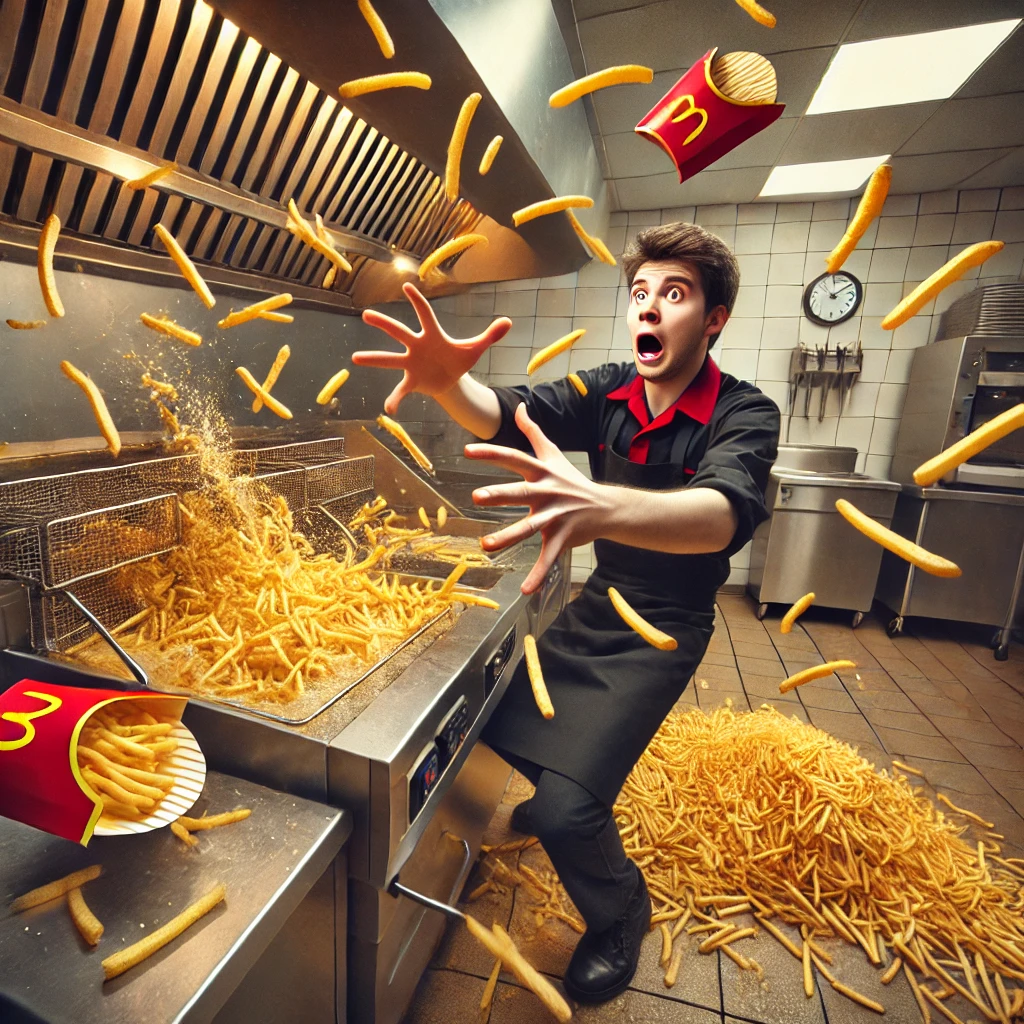
The grease burn is perhaps the most common of all McDonald’s injuries. You’ll be minding your own business, dropping fries into the vat, when suddenly a rogue bubble of oil decides it hates you. It leaps from the fryer, landing on your skin, and for a brief moment, you see your entire life flash before your eyes. The pain is sharp, quick, and always unexpected.
After a while, the burns start to blend together. Your skin becomes a patchwork of small red spots, each one a reminder that the fryer is never your friend. You’ll develop a technique for dropping baskets in at just the right angle to avoid the worst of it, but no method is foolproof. The fryer is unpredictable, and it will get you eventually.
Cuts are another rite of passage. The cardboard boxes that hold the frozen patties are deceptively sharp. You’ll be reaching in, trying to grab a stack of burgers, and suddenly you’re bleeding. It’s always a small cut, just enough to be annoying, but not enough to justify asking for a break. You’ll slap a bandage on it and get back to work, all while wondering if the burgers themselves are judging you for your weakness.
And then there’s the soda machine. It looks innocent enough, but it’s a ticking time bomb of potential disaster. You’ll be refilling a cup, adjusting the ice, and suddenly—bam—ice and soda are spraying everywhere. It’s on your face, your clothes, and somehow even in your shoes. The worst part is when you realize that your co-workers saw the whole thing, and they’re definitely not going to let you live it down.
Burns and cuts are one thing, but nothing compares to the emotional injury of being burned by a customer. Whether it’s the snarky comment about the ice cream machine or the complaint that their fries are too cold, these small jabs add up over time. You’ll learn to brush them off, but deep down, every “I want to speak to your manager” chips away at your soul.
Every McDonald’s employee eventually has a story about that one injury that stands out. Maybe it’s the time you dropped a hot apple pie on your foot, or the time you slipped on a rogue nugget and nearly face-planted into the fryer. Whatever it is, it becomes part of your story, a reminder that working at McDonald’s is not for the faint of heart.
But through all the burns, cuts, and bruises, you’ll develop a sort of pride. Each injury is proof that you’ve faced the chaos of fast food and survived. You’re not just making burgers—you’re fighting a war against the unpredictability of the kitchen, the chaos of the drive-thru, and the insanity of the general public.
The key is to embrace the pain. Laugh at the burns, shrug off the cuts, and wear your injuries like a badge of honor. They’re proof that you’re not just an employee—you’re a survivor. And at the end of the day, when you’re covered in fryer oil and sporting a new burn on your arm, you’ll know that you’ve earned every penny of that minimum wage.
So when someone asks you why you work at McDonald’s, show them the scars. Show them the burns, the bandaged fingers, and the stains that will never come out of your shoes. Tell them you work here because you’re tougher than they’ll ever be. And if they still don’t get it, offer them a McNugget and move on.
The Eternal McBreakfast Struggle: When Customers Forget What Time It Is
Working the breakfast shift at McDonald’s is an experience unlike any other. It’s early in the morning, you’re barely awake, and the smell of hash browns is the only thing keeping you conscious. You’re in the zone, making Egg McMuffins like it’s second nature. And then it happens: someone tries to order a Big Mac at 9 a.m.
The McBreakfast struggle is real, and it’s relentless. No matter how many times you explain that breakfast ends at 10:30, there will always be someone who just doesn’t get it. They’ll look at you, bewildered, as if you’ve personally destroyed their hopes and dreams by not allowing them a Quarter Pounder with cheese at sunrise.
They’ll argue. They’ll beg. They’ll plead. Some will even try to convince you that “nobody really likes breakfast anyway,” as if that’s going to make the eggs magically turn into a double cheeseburger. You’ll stand there, smile plastered on your face, wondering why they think you have the power to change the entire corporate policy just for them.
And then there are the ones who are too late. It’s 10:35, breakfast is over, and they missed it by five minutes. “But it’s just five minutes!” they cry, as if the sausage patty is somehow going to reappear just because they’re sad about it. You’ll have to be the bearer of bad news, explaining that the griddle is already full of burgers and there’s no turning back now.
But the absolute worst is the hybrid order. The customer who wants a McChicken and an Egg McMuffin at the same time. You’re running around, trying to juggle lunch items and breakfast items, and the entire kitchen descends into chaos. Nobody knows what’s going on. Fries are being thrown in with hash browns, and you’re desperately trying to hold it together while someone shouts, “I need an Egg McMuffin with no egg and extra pickles!”
And then there’s the shame. The deep, existential shame of admitting to someone that you’re out of breakfast burritos. “What do you mean you’re out?” they’ll ask, incredulous. It’s as if they’ve just discovered that Santa isn’t real, and you’re the one who broke the news. You’ll apologize, but it won’t help. Nothing can heal the wound of missing out on a mediocre breakfast burrito.
The key to surviving the breakfast shift is to stay calm and embrace the madness. Accept that there will always be someone who thinks they can outsmart the system. They’ll try to order a lunch item early, or a breakfast item late, and you’ll be stuck in the middle, holding the shattered pieces of their McDreams. Just smile, nod, and offer them a hash brown. It’s all you can do.
And when the clock finally strikes 10:30 and the breakfast rush ends, you’ll feel a strange sense of relief. You made it. You survived the endless barrage of confused customers, missing burritos, and hybrid orders. You’ll take a deep breath, look around at the mess, and prepare yourself for the lunch crowd. Because at McDonald’s, the chaos never truly ends.
Conclusion: The McReality of It All
Getting a job at McDonald’s is no small feat. It requires the kind of patience, resilience, and ability to swallow your pride that few other jobs demand. You’ll be tested, pushed to your limits, and covered in a variety of sauces. You’ll question your life choices, swear you’re going to quit at least once a week, and develop a strange sense of camaraderie with your fellow fry cooks and cashiers.
But here’s the thing: you’ll also learn a lot about yourself. You’ll learn that you’re tougher than you thought, that you can handle stress, angry customers, and broken machinery with something resembling grace. You’ll learn the secret language of the fryers, the dark mysteries of the ice cream machine, and how to smile through the chaos.
So, if you’re ready to embark on the McDonald’s journey, remember to bring your best fake smile, your willingness to endure the absurd, and a strong stomach for grease burns. You’ll need it. Welcome to the world of McDonald’s: where the fries are hot, the ice cream machine is always broken, and the customers are never, ever satisfied. But hey, at least the employee discount’s decent.